Understanding the Healthcare Revenue Cycle Process From Start to Finish

Every dollar a healthcare practice earns starts with a patient visit and ends as a payment; everything that happens in between is the revenue cycle. When it works well, claims go out clean, payments arrive on time, and staff spend their hours on patients rather than paperwork. When it breaks down, the damage shows up everywhere: denied claims, aging accounts receivable, and administrative teams stretched thin just to keep cash moving.
This guide walks through the healthcare revenue cycle management process step by step, from the moment a patient books an appointment to the moment their balance hits zero, and shows where the right tools close the gaps that cost practices the most.
Take Control of Your Revenue Cycle
Why Proper Revenue Cycle Matters
A healthcare revenue cycle process isn't just a billing formality. It's the financial engine that keeps a practice running. Every stage, from registration to reporting, touches cash flow, staff workload, and the patient relationship. A single error early on, like a mistyped policy number, can surface weeks later as a denied claim that costs far more to fix than it would have to prevent in the first place.
According to a survey, 62% of revenue cycle managers say dealing with underpayments and claim denials is their toughest financial challenge. Much of this trouble starts early in the process. Front-end issues such as registration errors and eligibility gaps are the primary triggers for these cash flow leaks.
Successful practices treat the healthcare revenue cycle as a collective, not a string of disconnected tasks. They consistently see fewer denials, faster payments, and less administrative strain. For a broader look at what's shaping billing operations this year, see our roundup of
medical billing trends.
Step-by-Step Guide to the Revenue Cycle Process
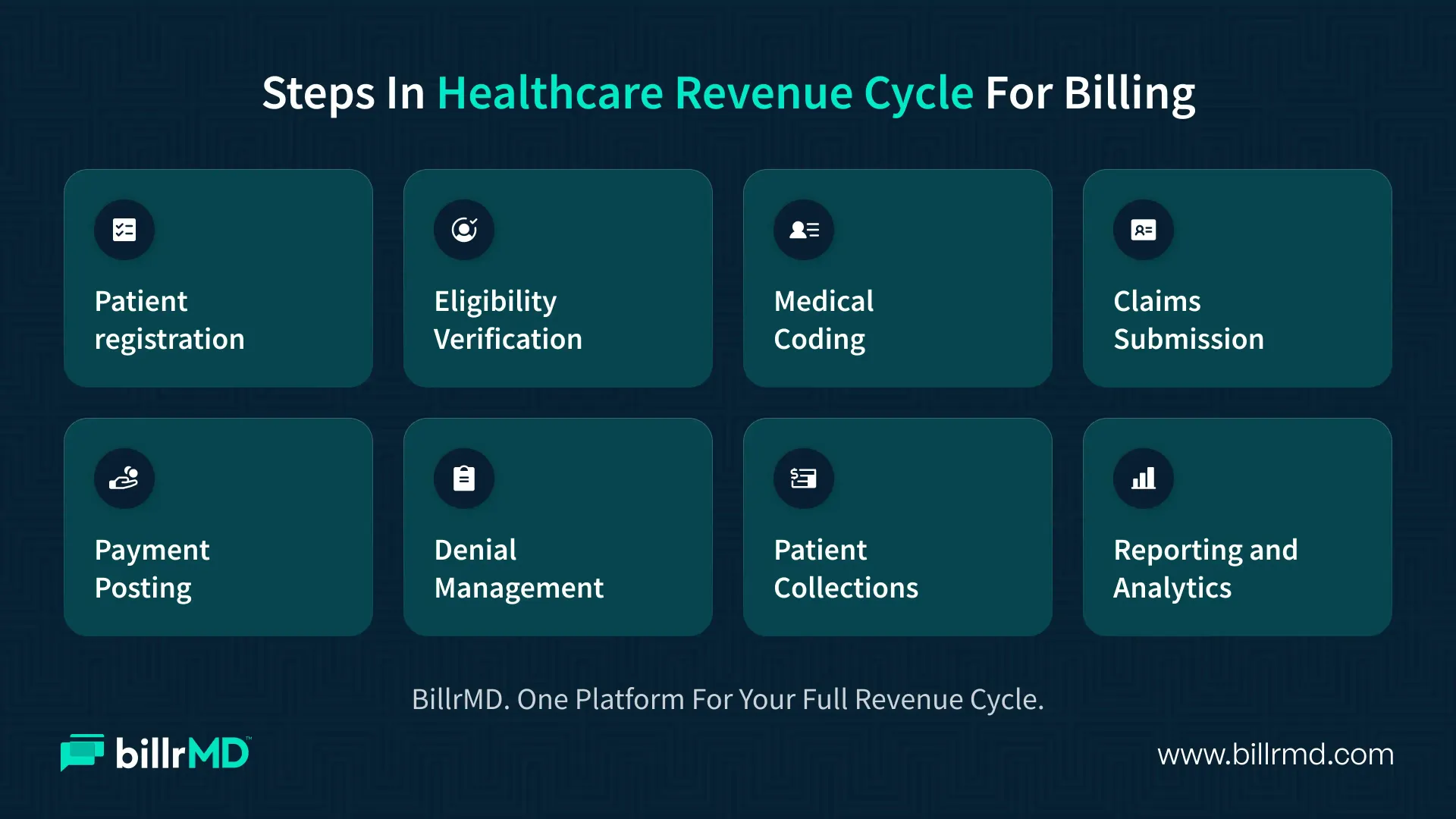
1. Pre-Registration and Patient Intake
Every claim starts with the information collected before a patient sees a provider. Front desk teams gather demographic information, insurance details, and a government-issued ID, and this data forms the foundation for every step that follows. A transposed digit or an outdated address here is often the root cause of a denial weeks later.
2. Insurance Eligibility Verification
Before the visit, confirm the patient's coverage is active, understand the plan's benefits, and flag any prior authorization requirements. Real-time eligibility checks catch coverage gaps before you render services, protecting revenue and helping patients understand what they'll be charged.
3. Charge Capture and Medical Coding
After the encounter, clinical documentation becomes billable charges through ICD-10 and CPT coding. Coding accuracy directly determines reimbursement. Vague or incomplete notes are one of the most common sources of downstream denials, so clear documentation at this stage pays off later.
4. Claim Scrubbing and Submission
Before a claim reaches a payer, it should run through claim scrubbing, an automated check for missing data, invalid codes, or formatting errors. Clean claims submitted electronically move faster and get rejected far less often than claims that skip this check. Our guide to the
complete medical billing process breaks this stage down in more detail.
5. Payer Adjudication and Payment Posting
Once submitted, the payer reviews the claim against plan rules and medical necessity, either approves it, pays part of it, or denies it. When payment arrives, posting it accurately, ideally through electronic remittance advice (ERA), tells your team exactly what was recovered and what remains.
6. Denial Management
Not every claim gets paid on the first try. Strong denial management means identifying the root cause, correcting it, resubmitting within the payer's appeal window, and tracking patterns over time so the same error doesn't recur.
7. Patient Billing and Collections
Once insurance pays its share, the remaining balance goes to the patient. Clear, itemized statements and simple digital payment options make a measurable difference in how quickly patients pay. This matters more each year:
high-deductible and HSA-eligible plans are becoming more common in the marketplace, which means patients are covering a growing share of the bill directly.
8. Reporting and Analytics
The cycle doesn't end at collection. Regular reporting and analytics on denial rates, days in accounts receivable, and collection percentages give practices the visibility to catch problems early, before they compound across hundreds of claims.
Manual vs. Software-Supported Revenue Cycle
Understanding the differences and payoffs between manual and software-supported revenue cycle management is core to practices wanting to correct their revenue cycle. The table below does exactly that:
| Stage | Manual Approach | Software-Supported Approach |
|---|---|---|
| Eligibility Verification | Phone calls or payer portals, checked one at a time | Real-time checks built into scheduling |
| Claims Submission | Manual data entry, paper or basic EDI | Automated scrubbing and electronic submission |
| Payment Posting | Line-by-line manual entry | Automatic bulk posting via ERA |
| Denial Tracking | Spreadsheets and ad hoc follow-up | Centralized dashboards with trend analysis |
| Reporting | Manually built reports | Real-time, customizable analytics |
How billrMD Improves Revenue Cycle Workflow
billrMD's medical billing and practice management software brings all these stages into a single web-based platform. You no longer have to juggle separate systems for scheduling, billing, and reporting. Real-time eligibility verification is built into the scheduling workflow, catching coverage issues before the appointment. Every claim runs through a scrubbing engine validated against more than 73,000 ICD-10, CPT, and DSM-5 codes, helping billrMD maintain up to a 99% first-pass acceptance rate for its clients.
Electronic Remittance Advice automates payment posting, eliminating the need for line-by-line manual entry. Configurable reporting dashboards provide practice managers with a real-time view of denial trends, accounts receivable aging, and overall cycle performance. Patient invoicing tools let practices send branded, itemized statements digitally, which shortens the time it takes patients to understand and pay their balance.
Investing in automation improves revenue cycle management. When you compare revenue cycle management software for healthcare process improvement, look for a platform that connects the front and back office rather than automating pieces of it in isolation. That's the gap billrMD is built to close. See how the right platform supports a full revenue cycle management strategy for more on building that connected approach.
Conclusion
The revenue cycle management process healthcare teams follow only works when every stage reinforces the next. Clean registration prevents an eligibility problem. Accurate coding prevents a denial. A tracked denial prevents a write-off. Practices that treat the cycle as one connected system, rather than a set of disconnected tasks, collect faster, collect more, and spend less time on rework.
Understanding the healthcare revenue cycle management process is the first step. The right platform turns that understanding into results. billrMD gives practices the infrastructure to run a financially healthy cycle at every stage, without adding complexity.
Rejuvenate Your RCM Workflows
Frequently Asked Questions
What is the revenue cycle management process in healthcare?
It's the sequence of financial steps a practice follows to convert patient care into payment. It covers registration, eligibility verification, coding, claims submission, payment posting, denial management, and patient collections.
What's the difference between medical billing and revenue cycle management?
Medical billing focuses on the claims-to-payment portion of the process. Revenue cycle management is the broader financial journey, starting at patient registration and ending only when the account balance reaches zero.
How do I compare revenue cycle management software for healthcare process improvement?
Look for real-time eligibility verification, automated claim scrubbing, electronic remittance advice, and reporting that connects data across the whole cycle rather than one stage at a time.
How can a practice reduce revenue cycle denials?
Start at the front end. Verifying eligibility and collecting accurate patient data before the visit prevents more denials than any downstream fix, and tracking denial patterns over time reveals where the real problems are.
Recent Posts