What Is Healthcare Revenue Cycle Management and How Does It Work?

Every healthcare organization runs on two things: patient care and the money that keeps the doors open. Revenue cycle management connects the two. It is the financial backbone that turns a patient visit into paid revenue, and when it breaks down, practices feel it through slow payments, denied claims, and mounting administrative work.
If you have ever wondered ‘what is revenue cycle management’ or why your billing team seems to be fighting the same battles every month, this guide breaks it down from the ground up. We will cover what RCM actually involves, why it matters, the challenges practices run into, and how the right software and strategy can turn your revenue cycle from a headache into a competitive advantage.
Billing Efficiency In Action
What Is Revenue Cycle Management in Healthcare?
Healthcare revenue cycle management is the process of tracking patient care from the moment an appointment is scheduled to the moment the account balance hits zero. It covers every financial touchpoint along the way: registration, insurance eligibility verification, coding, charge entry, claims submission, payment posting, denial management, and patient collections.
Think of it as the financial mirror of the clinical journey. While providers focus on diagnosis and treatment, the revenue cycle quietly works in the background to ensure care gets billed correctly, submitted on time, and paid in full. A strong revenue cycle management healthcare process does not just chase payments. It prevents problems before they happen, catching eligibility issues and coding errors long before a claim ever reaches a payer.
Why Is RCM Important in Healthcare?
Ask any practice administrator ‘why is RCM important in healthcare’ and the answer usually comes down to survival. Reimbursement rates are tighter, payer rules change constantly, and patients are responsible for a growing share of healthcare costs through deductibles, copayments, and coinsurance. Without a disciplined revenue cycle, even a busy, clinically excellent practice can struggle to stay financially healthy.
RCM is also the connective tissue between departments that do not always communicate. Front desk staff, coders, billers, and providers all touch the revenue cycle at different points, and a breakdown at any one stage can ripple through the rest.
Benefits of Revenue Cycle Management in Healthcare
The benefits of revenue cycle management in healthcare go beyond faster payments, though that is certainly part of it.
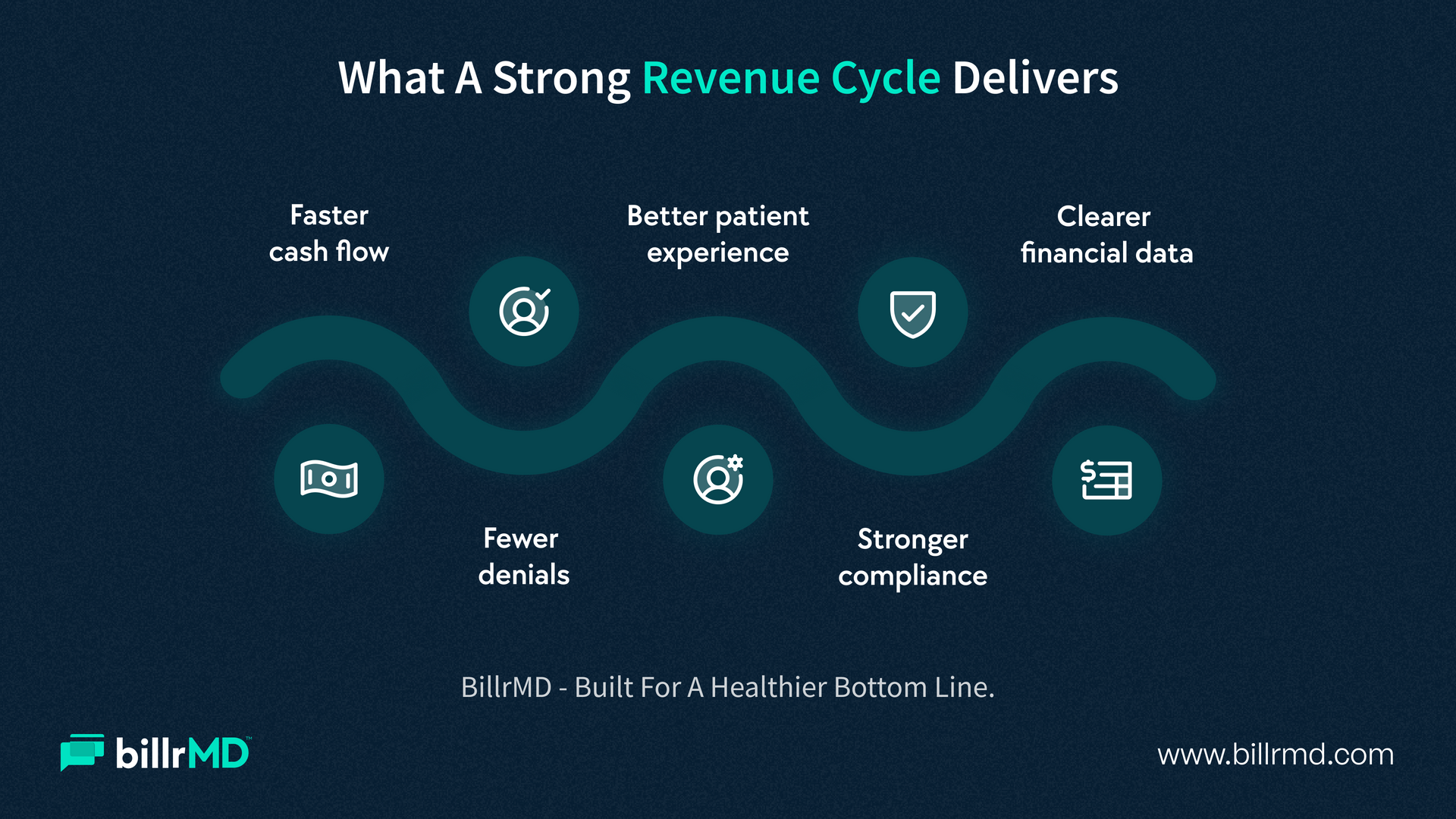
A well-managed revenue cycle gives practices:
- Faster, more predictable cash flow, since clean claims are more likely to be paid on the first submission instead of bouncing back for corrections.
- Fewer denials, because eligibility and coding issues get caught upfront instead of after a claim is rejected.
- Better patient experience, with clear billing statements and fewer surprise charges that erode trust.
- Stronger compliance, since a structured process reduces the risk of coding errors or documentation gaps that could trigger an audit.
- Data-driven decision-making, as reporting on claims, denials, and collections gives leadership a real-time view of financial health instead of a rearview mirror.
Taken together, these are the core benefits of revenue cycle management that separate financially stable practices from ones that are constantly playing catch-up.
Common Revenue Cycle Management Challenges
Even well-run practices run into revenue cycle management
challenges. The most common ones include:
Eligibility and authorization gaps
Insurance details change often, and a missed verification can turn into a denied claim weeks later.
Coding errors
Manual data entry and coding errors remain common contributors to denied and delayed claims.
Denial management overload
Reworking denied claims consumes staff time that could otherwise go toward new patient revenue, and many practices simply do not have the bandwidth to appeal every denial.
Fragmented systems
When scheduling, billing, and clinical records live in separate platforms, information falls through the cracks.
Staffing shortages
Many practices continue to face staffing challenges in revenue cycle operations, which puts more pressure on the systems and processes they already have in place.
These challenges are exactly why ‘how can a healthcare organization improve its revenue cycle management’ has become such a common search. The short answer is automation, better data visibility, and a platform that connects the front and back office instead of forcing staff to bridge the gap manually.
Revenue Cycle Management in Medical Billing
Revenue cycle management in medical billing follows a fairly consistent sequence, even though the details vary by practice and specialty:
- Patient registration and insurance verification, confirming coverage before the visit happens.
- Charge capture and medical coding, translating the visit into billable codes.
- Claims scrubbing and submission, catching errors before the claim goes to the payer.
- Payer adjudication, where the insurance company reviews and processes the claim.
- Payment posting, applying the payment to the patient account.
- Denial management and appeals for any claims that come back rejected.
- Patient billing and collections, closing out any remaining balance.
Every stage depends on the one before it. A mistake at registration shows up as a denial weeks later, which is why practices that treat RCM as one connected process, rather than a string of disconnected tasks, tend to see far fewer denials and faster payments.
Revenue Cycle Management Software
Manual RCM does not scale. As claim volume grows and payer requirements get more complex, revenue cycle management software becomes less of a nice-to-have and more of a necessity.
Good healthcare revenue cycle management software typically includes:
- Real-time insurance eligibility verification, so front desk staff know coverage details before the patient even sits down.
- Automated claims scrubbing, catching common errors before submission instead of after a denial.
- Electronic remittance advice (ERA) so payments post automatically instead of requiring manual entry.
- Customizable reporting and analytics, giving practices visibility into claim status, denial trends, and cash flow.
billrMD brings these functions into a single system rather than a patchwork of disconnected tools, which is often where revenue cycle management healthcare software earns its keep. When eligibility checks, claims scrubbing, and reporting all live in one place, staff spend less time switching between systems and more time catching issues before they become denials.
Future of Healthcare Revenue Cycle Management
The future of healthcare revenue cycle management is being shaped by automation and artificial intelligence. Providers are moving away from reactive billing, where problems get fixed after a claim is denied, toward predictive billing, where potential issues are flagged before a claim is ever submitted.
Automation is increasingly reshaping how practices manage claims and payments. Expect to see more AI-assisted coding, smarter denial prediction, and tighter integration between clinical and financial systems in the next few years. Practices that adopt these tools early will have a real advantage over those still relying on manual processes.
Why billrMD
billrMD brings the entire revenue cycle into one platform, built specifically for medical practices, billing companies, laboratories, and IDTFs. Instead of juggling separate tools for scheduling, eligibility, claims, and reporting, billrMD connects every stage of the process so nothing stays out of sync.
With real-time eligibility verification, automated claims scrubbing, electronic remittance advice, and customizable reporting, billrMD helps practices reduce denials, speed up payments, and get a clear, real-time view of their financial health. And because it is a two-in-one practice management and billing solution, billing companies and the practices they serve can work from the same system, which reduces errors and delays caused by disconnected platforms.
Boost Your RCM Strategy
Frequently Asked Questions
What is revenue cycle management in simple terms?
It is the process of managing the financial side of patient care, from scheduling an appointment through collecting final payment.
Why is RCM important in healthcare?
It keeps practices financially sustainable by reducing denials, speeding up payments, and giving leadership visibility into cash flow.
What are the main stages of the revenue cycle?
Registration, eligibility verification, coding, claims submission, payment posting, denial management, and patient collections.
How can a healthcare organization improve its revenue cycle management?
By automating eligibility checks and claims scrubbing, standardizing front-desk workflows, and reviewing denial and collections data regularly.
Recent Posts