Common Revenue Cycle Management Mistakes (and How to Avoid Them)

Revenue cycle management mistakes rarely show up as one big, obvious problem. They show up as a slightly higher denial rate that month, a claim that got kicked back for a coding issue, or a patient statement that never went out. On their own, each one looks minor. Add them up over a year, and they represent a significant amount of money your practice never collects.
Most revenue cycle management errors trace back to a handful of recurring issues: incomplete eligibility checks, coding inconsistencies, slow follow-up on denials, and systems that don't talk to each other. The good news is that once you know where these mistakes tend to happen, they're straightforward to fix. This guide breaks down the most common revenue cycle management mistakes healthcare practices make, why they happen, and what actually works to prevent them in the future.
Made For RCM Efficiency
What Do We Mean By Revenue Cycle Management Mistakes?
Revenue cycle management covers everything that happens between a patient booking an appointment and your practice collecting final payment for that visit. That includes eligibility verification, charge capture, coding, claims submission, payment posting, and patient billing. Understanding the medical billing process from start to finish makes it much easier to spot where things typically break down.
A revenue cycle management mistake is any breakdown in that chain that delays payment, reduces what you collect, or creates extra rework for your staff. Some are one-time errors, like a mistyped policy number. Others are systemic, like a practice management system that can't flag missing information before a claim goes out. Systemic mistakes cost practices the most because they repeat on every claim until someone catches the pattern.
Common Revenue Cycle Management Mistakes in Healthcare
These errors recur across practices, regardless of specialty or size.
Skipping or rushing eligibility verification
When coverage isn't confirmed before an appointment, billing surprises show up after the visit, for the patient and for your front desk as well. This is one of the most preventable revenue cycle management mistakes, yet it remains common because manual verification is time-consuming and easy to skip on a busy day.
Coding errors and incomplete documentation
Incorrect or outdated codes, missing modifiers, and documentation that doesn't fully support the billed service are consistent sources of denials. A coding mistake doesn't just delay one claim; it often signals a pattern that will keep repeating until the root cause is addressed.
Billing and submission errors
Billing and submission errors in healthcare range from mismatched patient information to claims submitted with the wrong payer details. Even small mismatches trigger a rejection before the claim ever reaches a reviewer, adding days or weeks to your collection timeline.
Weak or inconsistent denial follow-up
A denied claim isn't a lost claim unless someone follows up. Many practices lack a defined process for reviewing, correcting, and resubmitting denials within payer deadlines. As a result, recoverable revenue slips away simply because no one owns the task.
Disconnected systems
When scheduling, clinical documentation, and billing live on separate platforms, staff must re-enter information between them. Every manual handoff is a chance for something to get lost, mistyped, or delayed.
No visibility into performance
Practices that don't track metrics like denial rate, days in A/R, or first-pass acceptance rate manage the revenue cycle blind. Without that visibility, the same revenue cycle management errors happen month after month with no clear signal that anything needs to change.
How to Avoid Revenue Cycle Management Mistakes
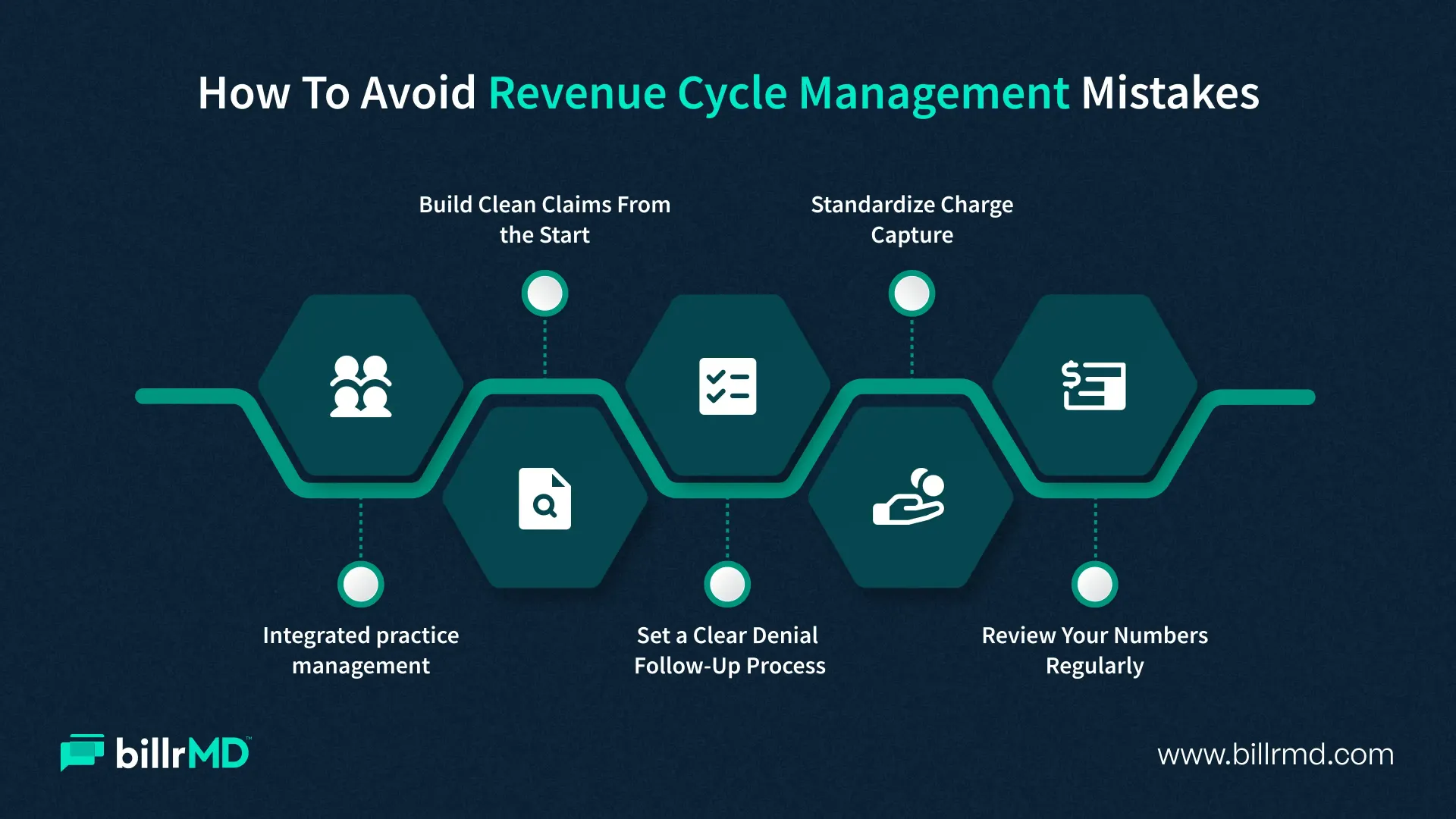
Avoiding revenue cycle management mistakes starts with treating prevention as a process, not a one-time fix.
Verify eligibility before every visit, not just the first one
Coverage changes more often than practices expect, and a quick check at each appointment closes one of the biggest gaps in the cycle.
Build clean claims from the start
That means accurate coding, complete documentation, and a scrubbing step that catches errors before submission, not after a denial.
Set a Clear Denial Follow-Up Process
A short, defined window for reviewing and appealing denials protects revenue that would otherwise age past the point of recovery.
Standardize charge capture
This ensures that the same service is coded and billed consistently every time, regardless of who's handling it that day.
Review your numbers on a regular basis
Denial rate, clean claim rate, and days in A/R tell you exactly where the cycle is breaking down, long before it becomes a bigger financial problem.
Best Practices to Improve Revenue Cycle Accuracy
Consistency is what separates practices with a smooth revenue cycle from practices firefighting denials every week. A few habits worth building into your workflow:
- Confirm patient demographics and insurance details at every check-in, not just at intake.
- Automate what can be automated, including eligibility checks, claim scrubbing, and payment posting, with a single, capable software platform that covers all these services.
- Set a policy for how quickly denials get reviewed after they arrive.
- Cross-train staff on your billing software so accuracy doesn't depend on one person being in the office.
Denial rates and administrative hurdles remain a massive financial headache for medical practices, especially as the healthcare industry averaged
12% claim denial in 2025. Top-performing groups use tight workflows to keep total denials under 5% and utilize advanced
RCM solutions.
Healthcare Revenue Cycle Management Trends 2026
Several healthcare revenue cycle management trends in 2026 are worth noting as practices plan their next moves. Automation continues to move from a nice-to-have to a baseline expectation. Electronic transactions and improved data exchange helped healthcare avoid an estimated $258 billion in administrative costs in 2025. This shows how much manual, repetitive work remains to be eliminated.
At the same time, rising operating costs are pushing practices to look harder at where their revenue cycle spend goes. A recent report shows physician practices face climbing year-over-year operational costs. Because these surging expenses heavily pressure margins, reducing administrative rework and preventable billing denials has become an immediate, mandatory strategy to protect revenue rather than an optional side project. For a closer look at what's shifting industry-wide, our roundup of medical billing trends covers the shifts worth planning around.
That's also driving more practices to evaluate the best revenue cycle management software 2026 has to offer, prioritizing platforms that combine claim scrubbing, real-time eligibility checks, and reporting into a
single system instead of stitching several tools together.
Revenue Cycle Management Software
Manual RCM does not scale. As claim volume grows and payer requirements get more complex, revenue cycle management software becomes less of a nice-to-have and more of a necessity.
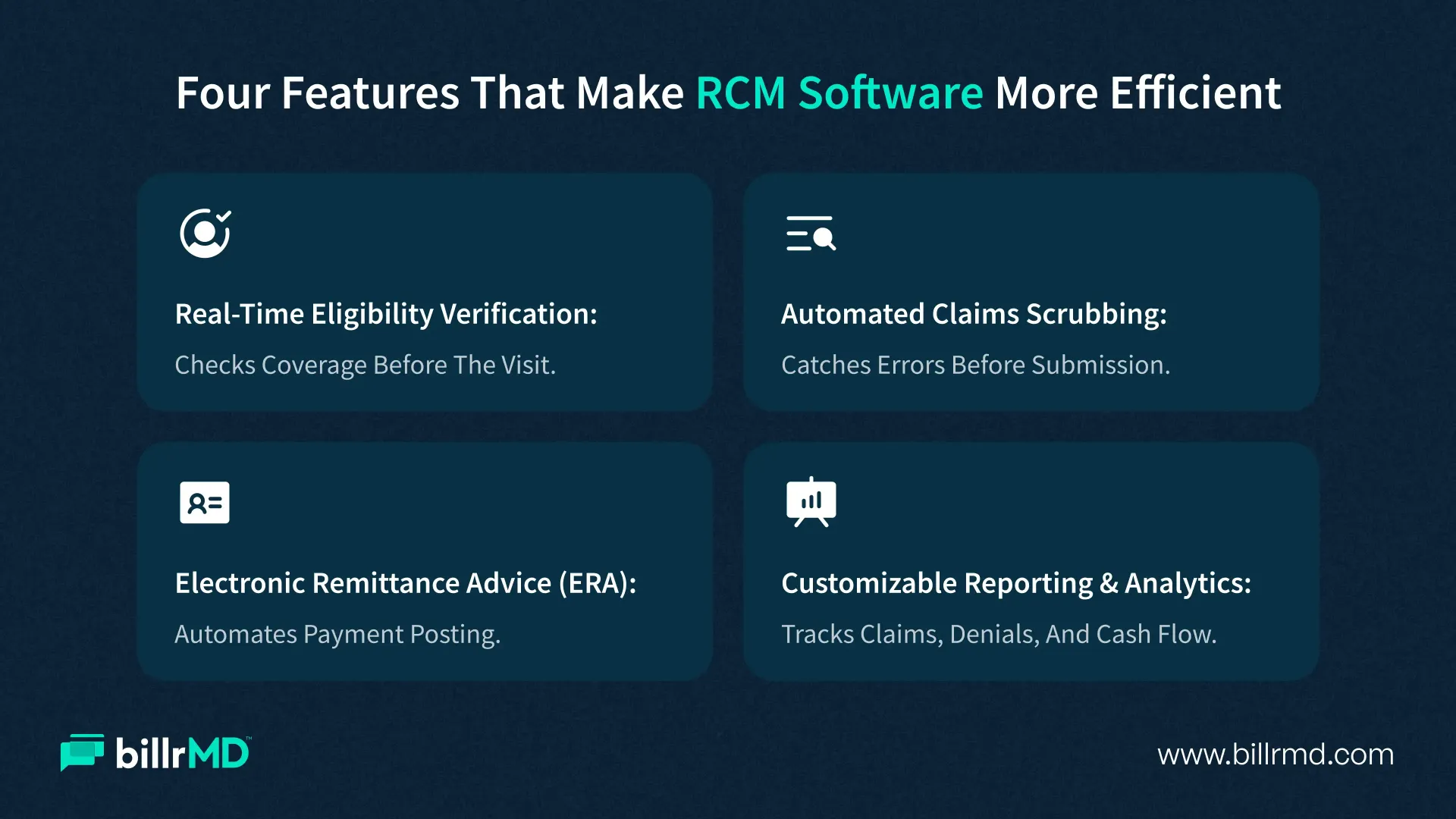
Good healthcare revenue cycle management software typically includes:
- Real-time insurance eligibility verification, so front desk staff know coverage details before the patient even sits down.
- Automated claims scrubbing, catching common errors before submission instead of after a denial.
- Electronic remittance advice (ERA) so payments post automatically instead of requiring manual entry.
- Customizable reporting and analytics, giving practices visibility into claim status, denial trends, and cash flow.
billrMD brings these functions into a single system, which is often where revenue cycle management healthcare software earns its keep. When eligibility checks, claims scrubbing, and reporting all live in one place, staff spend less time switching between systems and more time catching issues before they become denials.
How billrMD Helps
billrMD is built to prevent the mistakes that drain revenue. Here’s how:
- Claims scrubbing engine checks claims against 73,000+ ICD-10, CPT, and DSM-5 codes before submission.
- Practices achieve up to a 99% first-pass acceptance rate.
- Real-time eligibility verification identifies coverage issues before appointments.
- Electronic Remittance Advice automates payment posting, eliminating manual entry.
- Built-in reporting and analytics provide visibility into denial trends, claim status, and collection performance from a single dashboard.
As a full
medical billing software and practice management platform, billrMD brings scheduling, billing, and reporting together. This closes many of the gaps that cause revenue cycle management mistakes in the first place. If you're rethinking the right billing and practice management software for your practice, this is a good place to start.
Optimize Your RCM Strategy
Frequently Asked Questions
What are the most common revenue cycle management mistakes?
The most frequent issues are skipped eligibility checks, coding errors, incomplete documentation, slow denial follow-up, and disconnected systems that require manual data entry between platforms.
How do revenue cycle management mistakes affect a practice's bottom line?
Each mistake adds delay, rework, or lost revenue. Combined, they show up as a higher denial rate, longer days in A/R, and lower collections relative to what was actually billable.
What's the fastest way to start avoiding revenue cycle management mistakes?
Start with eligibility verification at every visit and a defined denial follow-up process. These two changes address a large share of preventable revenue loss without a full system overhaul.
How does billrMD support revenue cycle accuracy?
billrMD combines claim scrubbing, real-time eligibility verification, automated remittance posting, and reporting tools in one platform, closing the gaps where most revenue cycle mistakes happen.
Recent Posts