Best Revenue Cycle Management Software in 2026: A Complete Guide
Choosing revenue cycle management software is not a decision most practices get to make casually. The wrong fit can leave your team dealing with more manual work, slower collections, and another system to manage. Meanwhile, denials, payer changes, and administrative workload keep piling up. The global revenue cycle management market is valued at USD 163.7 billion in 2025, projected to reach USD 368.9 billion by 2034. Denial rates for providers are also on the rise. So, the right partner can mean the difference between predictable cash flow and a growing backlog of unpaid claims.
We looked at five of the best revenue cycle management software companies that practices, billing companies, and labs may come across while comparing their options in 2026.
The focus here is on smaller and growing organizations, particularly independent practices, billing companies, and labs. We'll cover what each revenue cycle management software does well, who it fits best, and how to approach the decision before you sign a contract.
Right-Sized RCM Software
What Is Healthcare Revenue Cycle Management Software?
Healthcare revenue cycle management software brings together the administrative and billing workflows that move a claim from scheduling and eligibility through submission, payment, denial follow-up, and final collection. Some vendors sell software only. Others combine software with outsourced billing teams. Some also combine billing with practice management tools, while others focus more narrowly on the practice's financial side.
The need for better RCM tools is easy to understand. Every avoidable rejection, unresolved denial, and unpaid patient balance creates more work for a team that is already juggling scheduling, documentation, and day-to-day practice operations.
The right revenue cycle management software solutions can help practices catch billing issues earlier. It also keeps claims moving and reduces repetitive work involved in managing the revenue cycle.
What to Look for in a Revenue Cycle Management Software
Not every vendor on a healthcare revenue cycle management software companies list solves the same problem. A few questions can quickly separate a genuinely good fit from a platform that simply looks good in a demo.
Claims and denial management.
How does the platform catch errors before submission, and how does it handle denials once they happen?
Denial management matters, but look beyond whether a vendor simply says it “manages denials.” Ask how the workflow actually works.
Integration.
Does it plug into your existing EHR and practice management system, or does it require replacing what you already have?
Reporting.
Can you track first-pass rate, days in AR, and net collection rate by payer and provider?
Service model.
Are you buying software you run yourself, a platform with optional managed billing, or something in between?
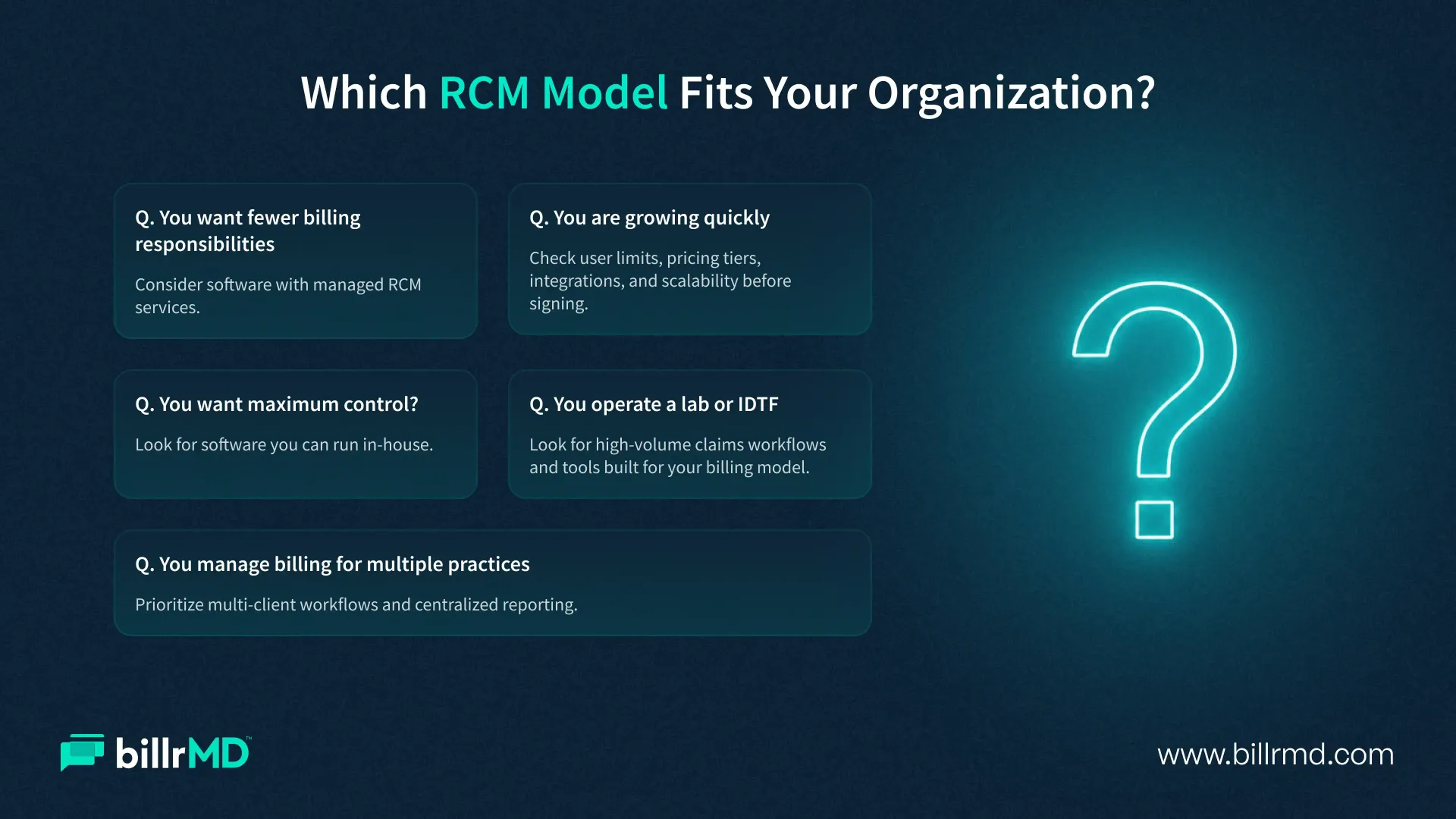
The priorities change depending on who is buying. A solo practice may care most about cost and ease of use, while a billing company needs multi-client workflows and centralized reporting. Labs and IDTFs may put more weight on billing volume and workflow flexibility.
5 RCM Software to Consider in 2026
1. billrMD
billrMD is a web-based practice management and medical billing platform built for medical practices, billing companies, and labs and IDTFs. It handles electronic claims submission through an integrated clearinghouse, claims scrubbing, denial management, and electronic remittance advice, alongside scheduling, a patient portal, and real-time reporting. It is fully web-based with no downloads or on-site servers, and it offers a free plan to start submitting claims right away, with paid plans adding unlimited non-provider users and premium reporting as a practice grows.
Best for:
Independent practices, billing companies, and labs or IDTFs that want one web-based platform without paying for a large enterprise system.
Why it stands out:
billrMD offers a free starting plan and paid plans from $149 per provider per month, giving smaller organizations a lower-cost way to start and scale.
2. AdvancedMD
AdvancedMD has EHR, practice management, and billing capabilities. It offers configurable billing workflows, telehealth support, and dashboards that track accounts receivable by payer.
Best for: Practices that want a highly configurable EHR, practice management, and billing platform and are willing to invest in a broader software suite.
Keep in mind: AdvancedMD offers extensive bundles and add-ons, but that broader setup can make it a more expensive option for smaller practices. Its published medical-specialty pricing currently ranges from $429 to $1,070 per provider per month, depending on the configuration.
3. athenahealth
athenahealth connects EHR, scheduling, and revenue cycle tools in one platform, with payer rules and a broad app marketplace for add-on integrations.
Best for: Practices looking for a broader EHR, practice management, and RCM ecosystem with outsourced or co-sourced revenue cycle support.
Keep in mind: Athenahealth has a rigid user interface with limited customization, so practices must adapt to preset workflows, and strict automated scrubbers can slow claim submissions for specialties.
4. NextGen Healthcare
NextGen Healthcare pairs practice management software with optional RCM services, including eligibility verification, coding support, and accounts receivable recovery for ambulatory and multi-specialty groups.
Best for:
Multi-provider and growing ambulatory organizations that need a broader practice management and RCM ecosystem, with optional hands-on services.
Keep in mind: NextGen makes more sense as practices grow in size and operational complexity. Smaller organizations may not need the breadth of a larger platform.
5. CureMD
CureMD combines AI-driven billing automation with an optional managed billing service, covering insurance verification, prior authorization, and payment posting for practices that want to hand off some or all of their billing.
Best for: Practices that want their software and billing operations handled through one vendor, including managed RCM services.
Keep in mind: Practices should look closely at how much control they retain over billing workflows when choosing a vendor-managed model. That hands-on support can be useful, but it may be more than a practice needs if its billing team wants to manage the process internally
How We Chose These Software
We selected these platforms based on their fit for independent practices, billing companies, and labs, as well as the breadth of their RCM capabilities. Additionally, we considered their software and service models, along with how well their pricing and positioning align with different practice sizes. We left out large hospital and health-system platforms, since those solve a different problem than what most independent practices, billing companies, and labs are dealing with day-to-day.
Conclusion
There is no single best revenue cycle management software for every organization. A solo practice and a five-location billing company managing several clients need different things from a vendor, even if both call it RCM. Start with your patient volume, your staffing, and how much of the billing work you want to keep in-house. From there, the right choice comes down to how much control you want, how much support you need, and what you're willing to pay as your organization grows. For organizations that want a straightforward, web-based system without moving into a larger enterprise platform, billrMD is worth a closer look.
Try billrMD for Free
Frequently Asked Questions
What is the best revenue cycle management software for an independent or growing practice?
There is no single answer for every practice. Start by deciding whether you want to manage billing in-house or have a vendor handle part of the work. Then compare pricing, integrations, claims and denial workflows, reporting, and the level of support included.
What is the difference between RCM software and outsourced RCM services?
RCM software gives your team tools to manage claims, denials, and payments in-house. Outsourced RCM services hand some or all of that work to an external team. Some vendors combine the software with managed billing services, while others primarily give your team the tools to manage the work internally.
How do I compare revenue cycle management software?
Look at claims accuracy, denial management capability, how well it integrates with your current systems, and how clearly the vendor prices its plans. Ask for a live demo before you commit.
Does a billing company or lab need different RCM software than a medical practice?
Not necessarily, but it helps to use a platform built to handle both. billrMD supports medical practices, billing companies, and labs and IDTFs on the same system, so billing companies can manage multiple clients and labs can handle high claim volumes without switching platforms.
Recent Posts