How to Correct Common Medical Billing Errors Before They Cost You Revenue

Most billing errors aren't dramatic and sudden. They're small, like a transposed digit in a policy number, a missing modifier on a procedure, or a prior authorization that never got filed. Some can stall a claim for days or even weeks, and together they drain revenue from practices of every size.
This guide covers the common medical billing errors behind those delays, what they cost, and how to fix them for good.
Prevent Claim Denials
What Are Common Medical Billing Errors?
Medical billing errors are mistakes in data, codes, or workflow that keep a claim from being paid correctly the first time. Some are clerical, like a misspelled name. Others are coding slips, like a wrong modifier. A few are process gaps, like a missed filing deadline.
Two outcomes matter here. A rejection means the claim failed basic checks and never reached the payer's review. A denial means the payer adjudicated the claim and determined that it would not pay all or part of it. Rejections are usually quick fixes. Denials take more work.
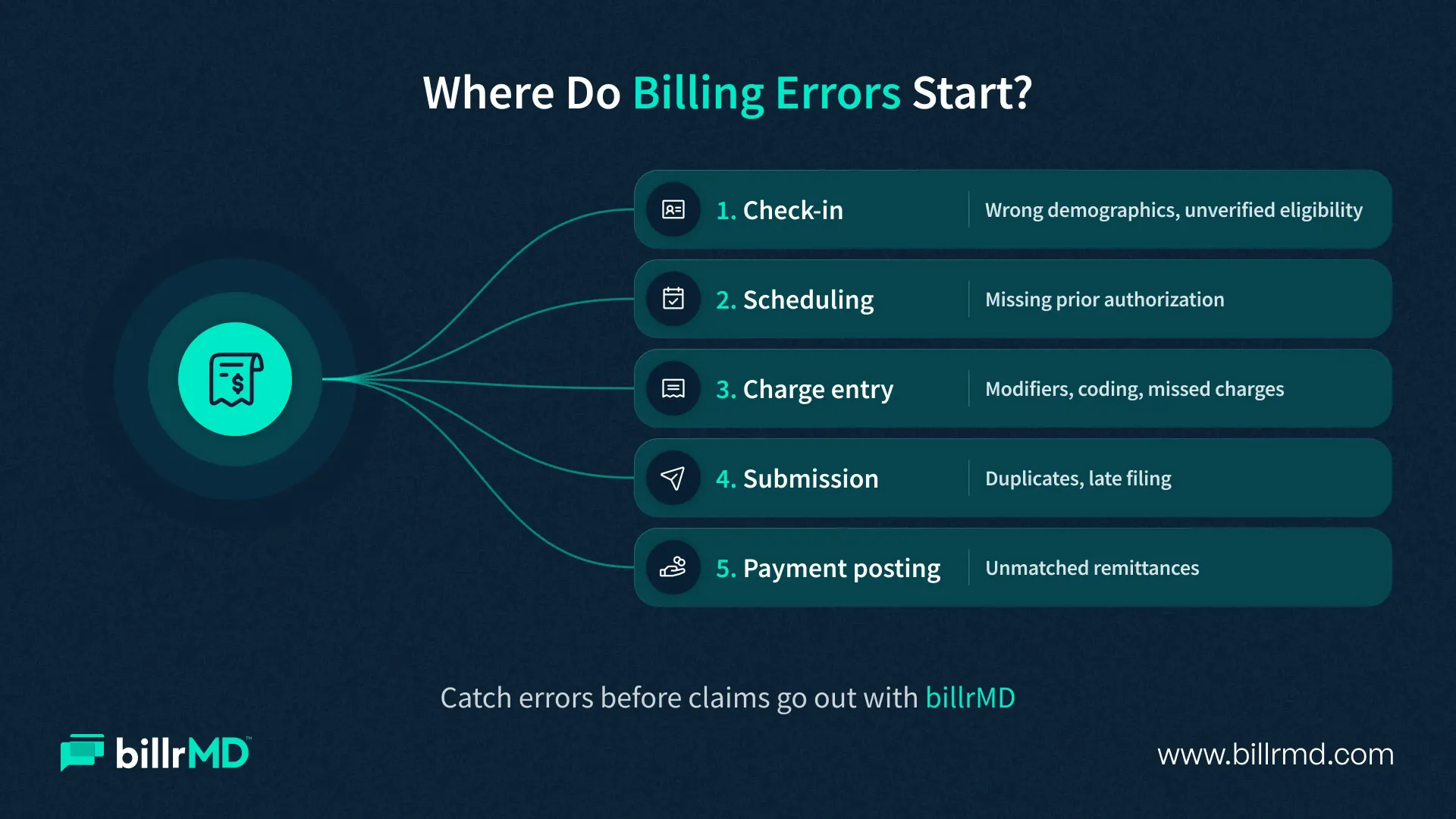
Most errors start long before the claim exists. They begin at scheduling, check-in, or charge entry, then travel downstream until a payer catches them.
Medical Billing Errors Statistics and What They Cost Your Practice
No single number tells the whole story; these three stats help frame the scale of the problem.
1. CMS estimated a
6.55% improper payment rate for Medicare fee-for-service in fiscal year 2025, representing $28.83 billion. This measures payments that did not meet program requirements, not medical billing errors or fraud. CMS reported that most improper payments occurred when insufficient documentation made it unclear whether payment was proper.
2. ACA Marketplace coverage shows a higher denial rate. A report found that HealthCare.gov insurers denied
19% of in-network claims in 2024. This covers Marketplace plans only and is not directly comparable to a practice’s own denial rate.
3. For physician practices, a poll puts first-submission denials at 7% to 8% across the past four years. It adds that targeted process fixes can push the rate below 5%. In a January 2026 poll,
48% of leaders named denials and appeals their biggest source of revenue leakage.
Those medical billing error statistics point to costs that go beyond the denied claim. A denial can send a balance back through the collection cycle and add rework, potentially aging the receivable further. Staff lose hours to rework instead of new claims. Repeated coding patterns can draw payer audits. Missed filing windows turn a delay into lost revenue. Patients feel it too, through confusing statements and surprise balances.
10 Most Common Medical Billing Errors and How to Fix Them
Here are the most common medical billing errors, with the cause and the fix for each.
1. Incorrect patient demographics
A misspelled name, incorrect birth date, or outdated address can trigger a rejection. These slips usually happen at check-in. Verify demographics at every visit and confirm the details with the patient.
2. Unverified eligibility and the wrong payer
Policies lapse, plans change, and patients mix up Medicare Advantage with traditional Medicare. Billing the wrong payer, or the wrong primary and secondary order, sends the claim back unpaid. Check eligibility before each visit and confirm coordination of benefits when two plans apply.
3. Missing prior authorization or referral
Many services need approval before the visit. A missing, expired, or mismatched authorization leads to a denial. Track requirements by payer and procedure, and record the approval number in the chart so billing can attach it.
4. Missing or incorrect modifiers
Modifiers tell the payer why a service differs from its standard code. Leave one off, or add the wrong one, and a valid service looks like a mistake.
Modifier 25 is a frequent trouble spot. Audit modifier use quarterly and retrain when payer rules change.
5. Coding errors and outdated codes
Wrong diagnosis codes, mismatched procedure codes, and retired codes cause denials and compliance risk. Undercoding costs revenue, while upcoding invites audits. Update code sets after each annual release and pair every diagnosis with the service it supports. Our guide to Medical Billing vs Medical Coding provides more insights.
6. Unbundling
Billing separate codes for services that belong under one bundled code inflates the claim. Bundling edits can flag these claims for review or denial. Check bundling rules, such as
NCCI edits, before submission.
7. Duplicate claims
Resubmitting a claim that's still pending can trigger a duplicate denial. It usually happens when staff can't see claim status. Check status before you resubmit, and keep pending claims in one view.
8. Insufficient documentation
A claim is only as strong as the note behind it. Missing medical-necessity language, unsigned encounters, or missing orders lead to denials and failed audits. Close notes promptly and use a short checklist for services payers question often.
9. Missed timely filing deadlines
Claim and appeal deadlines vary by payer and program. Miss it, and the revenue is usually gone. Keep a deadline calendar by payer and work the oldest claims first.
10. Charge capture and payment posting mistakes
Some errors hide after the visit. A service may never get billed, or a payment may land on the wrong account. Both distort your numbers. Reconcile charges against the schedule weekly, and match every remittance to its submitted claim.
How to Correct Medical Billing Errors
Here's how to correct medical billing errors without guessing. The right fix depends on whether you're facing a rejection or a denial.
Step 1: Read the reason code
Remittance advice lists adjustment and remark codes that explain a denial. Rejections show up in clearinghouse reports. Either way, the code tells you what failed.
Step 2: Sort the problem
A rejection needs corrected data and a resubmission. A denial caused by your mistake needs a corrected claim. If you believe a denial is wrong, you need an appeal.
Step 3: Fix the source
Correct the registration record, chart, or charge, not just the claim. Otherwise, the same error returns next week.
Step 4: Send it the right way
Corrected-claim requirements vary by payer; many electronic workflows require a replacement-claim indicator and the original claim reference number. For an appeal, attach the records and cite the payer's policy. Check payer rules and deadlines first.
Step 5: Log and learn
Record the cause, the date sent, and the follow-up deadline. Review the log monthly to spot repeat errors by payer, provider, or code.
How billrMD Helps Reduce Medical Billing Errors
billrMD is a web-based billing and practice management platform that catches errors early and speeds up fixes. Here’s how:
- Real-time claim scrubbing:
billrMD flags errors before submission and keeps up with billing code updates. Problem claims come back for correction and resubmission instead of reaching the payer. - Claim tracking:
Monitor claims one at a time or in batches, so staff see what's pending before anyone resubmits. Connections to multiple clearinghouses open a wide payer network. - Automatic
ERA posting:
Insurers send ERAs directly to billrMD, and you confirm them with a click. The system cross-checks remittances against submitted claims to surface discrepancies. - Denial insight:
The denials analysis tool shows which services and codes cause denials, so you can fix root causes. Claim aging and payment reports show what's still unpaid.
You can start with a free billrMD account, and no credit card is required.
Conclusion
Billing errors are common, but they're rarely random. Most trace back to a few causes: faulty front-desk data, coding and modifier slips, missing approvals, and missed deadlines. Fix those at the source, scrub claims before submission, and track first-pass results by payer. Small, steady changes add up, and practices that catch errors early spend less time on rework and more on patients.
billrMD is here to make sure your practice operates without revenue loss. If you'd like more insights, we’re just a phone call away.
Start Sending Cleaner Claims
Frequently Asked Questions
What are the most common medical billing errors?
The most common medical billing errors include wrong patient data, unverified eligibility, missing prior authorizations, modifier mistakes, coding errors, duplicate claims, and missed filing deadlines. Most start at registration or charge entry.
How do you correct a medical billing error after submission?
Read the denial or rejection code, fix the source data, then send a corrected claim. File an appeal if the denial was wrong. Check the payer's deadline before you start.
How often should a practice audit its claims?
Monthly sample audits work well for many practices. Add a deeper review after each annual code update or major payer policy change.
Can billing software prevent medical billing errors?
Software can't fix bad data entry, but it can catch many errors before submission and show where they cluster. Claim scrubbing and denial reports matter most here.
Recent Posts