What Is a Healthcare Clearinghouse and How Does It Process Claims?

A denied claim rarely announces itself as a big problem. It just sits there, unpaid, while your staff tries to figure out what went wrong. Claim problems can start before they reach the payer, which is why practices use healthcare clearinghouses to check, format, and route electronic claims. If you've ever wondered ‘what is a healthcare clearinghouse’ or how it fits into your billing workflow, here's a comprehensive look at how it works.
Billing Efficiency In Action
What Is a Healthcare Clearinghouse?
HRSA defines healthcare clearinghouses as medical intermediaries that exchange data between providers and insurance companies by translating between standard and non-standard transaction formats. When a practice submits claims through a clearinghouse, the clearinghouse receives the electronic claim, processes it for the required format, and forwards it to the payer.
In practical terms, it gives a claim another check before submission. A clearinghouse in healthcare can check claims for formatting and data errors, apply available validation and payer-specific edits, and route them using the appropriate electronic transaction format. It's not the same as a billing service. A billing company manages your entire revenue cycle, while a clearinghouse focuses specifically on getting claims through cleanly and getting responses back fast.
What Happens During Claims Submission?
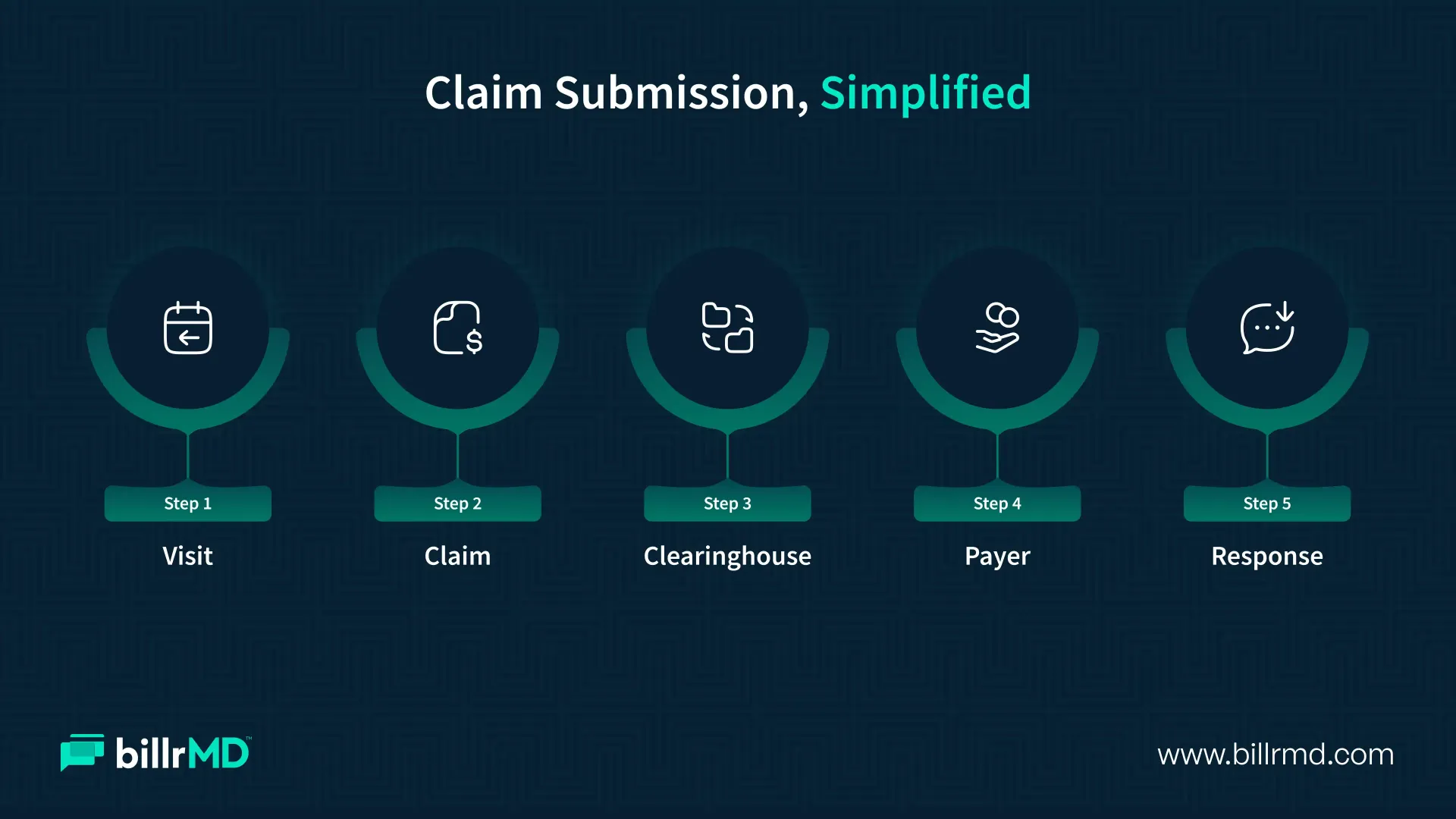
Before a claim reaches an insurance company, it passes through several stops. The workflow generally looks like this:
- A patient is seen, and the visit is documented.
- Your practice management or EHR system generates the claim.
- When the practice uses a clearinghouse, the claim is transmitted electronically to the clearinghouse.
- The clearinghouse can check the claim for missing or invalid data and formatting issues before forwarding it.
- The clearinghouse routes clean claims to the correct payer.
- Acknowledgment and status updates flow back to your team.
Electronic submission and clearinghouse processing can happen quickly, but payer acknowledgments, claim processing, and payment happen on separate timelines.
Without a clearinghouse, a practice may use other time-consuming submission methods, depending on the payer and its billing setup.
What Does a Healthcare Claims Clearinghouse Actually Do?
Electronic health care claims use standardized transactions such as the ASC X12N 837 under
HIPAA. Once a claim lands in the clearinghouse, several things happen almost simultaneously. These are the core healthcare clearinghouse functions worth understanding:
Eligibility verification
Clearinghouse-connected systems can support electronic eligibility and benefits inquiries, including information such as coverage, deductibles, copayments, and coinsurance, depending on the payer and transaction.
Claim scrubbing
Depending on the clearinghouse and its validation rules, automated edits can flag issues such as missing data, invalid identifiers, or formatting errors before submission.
Payer routing
A clearinghouse can translate and format transactions as needed and route them to participating payers.
Acknowledgments
After submission, electronic acknowledgments can indicate whether a transaction was received, passed specific validation, or was rejected for correction.
Status tracking
A clearinghouse-connected system can consolidate claim-status information, reducing the need for staff to check multiple payer systems manually.
Electronic claim-status transactions allow providers to request and receive claim-status
information without relying exclusively on manual calls or portal checks.
Remittance processing
Once a payer processes a claim, an electronic remittance advice (ERA) can be returned through the clearinghouse and used to support payment posting and reconciliation.
Together, these functions separate a modern, automated claims process from one that depends on manual follow-up.
How a Healthcare Clearinghouse Helps Medical Practices
The value of a healthcare claims clearinghouse becomes obvious once you look at what manual claims processing costs. Electronic transactions can reduce administrative work by replacing manual processing with standardized electronic workflows.
For individual practices, that can mean:
- Fewer denials: Claims get caught and corrected before they reach the payer.
- Faster payment: Clean claims move through the payer's system without delay.
- Less staff time on rework: Billing teams spend less time chasing rejections.
- Clearer visibility: One dashboard shows claim status across every payer.
These healthcare clearinghouse solutions can be useful when a practice is trying to reduce manual claim work. A clearinghouse cannot prevent every denial, but catching avoidable submission errors before a claim reaches the payer can reduce unnecessary rework.
Common Claim Rejections a Clearinghouse Can Catch
Some claim problems appear repeatedly in the submission process. A clearinghouse is built to catch these before they cost you time:
- Patient name or date of birth mismatch
- Missing or invalid claim data
- Expired or incorrect insurance ID
- Missing rendering provider or procedure code
- Invalid subscriber or member information
- Missing or invalid provider information
- Formatting or transaction errors
Catching certain errors before submission can reduce avoidable rework and give the billing team a chance to correct the claim sooner. A rejection caught in minutes costs far less than one discovered weeks later during a follow-up call.
Common Problems a Clearinghouse Helps Solve
Beyond individual rejections, a clearinghouse addresses some of the bigger operational headaches practices deal with:
- Disconnected systems:
Instead of logging into separate payer portals, your team works from one interface for submission, tracking, and remittance. - Manual follow-up:
Electronic claim-status transactions can reduce the need for repeated calls or portal checks. - Inconsistent formatting:
Payers can have different transaction and submission requirements. The clearinghouse handles translation automatically. - Revenue leakage:
Unresolved claim problems can create additional follow-up, rework, and delayed payment.
For smaller practices, a clearinghouse can reduce the manual work involved in claim submission, tracking, and electronic remittance.
Getting Claims Right the First Time with billrMD
This is where billrMD's integrated workflow is relevant. billrMD is a web-based practice management and medical billing platform built around an integrated clearinghouse, powered by Availity Essentials Pro, an all-payer network that delivers real-time eligibility checks, advanced claim scrubbing, ERA, and end-to-end claims tracking in one workflow. Instead of bolting a clearinghouse onto your existing system, it's built directly into how billrMD processes every claim.
Want the bigger picture? Our guide on
claims management in healthcare walks through the full process from registration to payment. Comparing platforms? Our guide to
choosing the right RCM software covers what to look for beyond the clearinghouse itself. And you can see the full billing workflow in our
step-by-step medical billing process guide.
Conclusion
A clearinghouse is one part of the claim workflow, but it can take several repetitive steps out of the submission process. It catches errors before they become denials, helps the team identify and address submission issues sooner, and gives your team visibility they wouldn't have working payer by payer.
Whether you're evaluating your current setup or looking to switch, understanding how a clearinghouse works is the first step toward fewer denials and faster payments. A good setup should make the submission process easier to manage without hiding what is happening to the claim.
Try billrMD for Free
Frequently Asked Questions
What is a healthcare clearinghouse?
A healthcare clearinghouse is a third-party service that checks, formats, and electronically transmits medical claims between a practice and an insurance payer, reducing errors before submission.
What is a clearinghouse for medical claims used for?
It verifies eligibility, scrubs claims for errors, routes them to the correct payer, and returns status updates and remittance information back to the practice.
Is a clearinghouse the same as a billing company?
No. A billing company manages the full revenue cycle. A clearinghouse focuses specifically on checking and transmitting claims accurately.
How long does it take to hear back after a claim is submitted?
The timing depends on the type of response. A submission acknowledgment can arrive quickly, while payer claim status, adjudication, and payment follow separate timelines.
Recent Posts