Understand The Complete Medical Billing Process From Claims to Payments

Managing your healthcare practice is not only about offering quality patient care. It is also about managing your revenue cycle efficiently. The medical billing procedure is the lifeline of your medical practice’s financial health. However, it is often one of the most challenging procedures in your medical practice.
Every step in the medical billing process, from patient registration to claim filing and payment posting, should be compliant. Any single mistake in the procedure, such as using an incorrect modifier or outdated patient insurance information, can result in claim denials, delayed payments, or even compliance issues.
In this guide, we’ll break down the medical billing process step by step, explore how medical billing software can streamline your workflow, and share actionable tips to improve your revenue cycle management.
Medical Billing Made Easy
What Is the Medical Billing Process?
The medical billing process is the sequence of steps healthcare providers follow to convert clinical services into reimbursements. It covers everything from patient intake and insurance verification to claims submission, payment collection, and ongoing financial reporting.
It's worth drawing a clear line between billing and coding, since the two often get treated as the same thing. Medical coding translates clinical documentation into standardized diagnosis and procedure codes. Medical billing uses those codes to build claims and submit them to payers. Both are essential, and coding errors feed directly into billing outcomes.
The RCM process in medical billing, or revenue cycle management, is the umbrella term for the entire financial journey of a patient encounter. When managed well, the cycle produces fewer denials, faster reimbursements, and more predictable cash flow. When it's fragmented, small problems in early steps create expensive ones downstream.
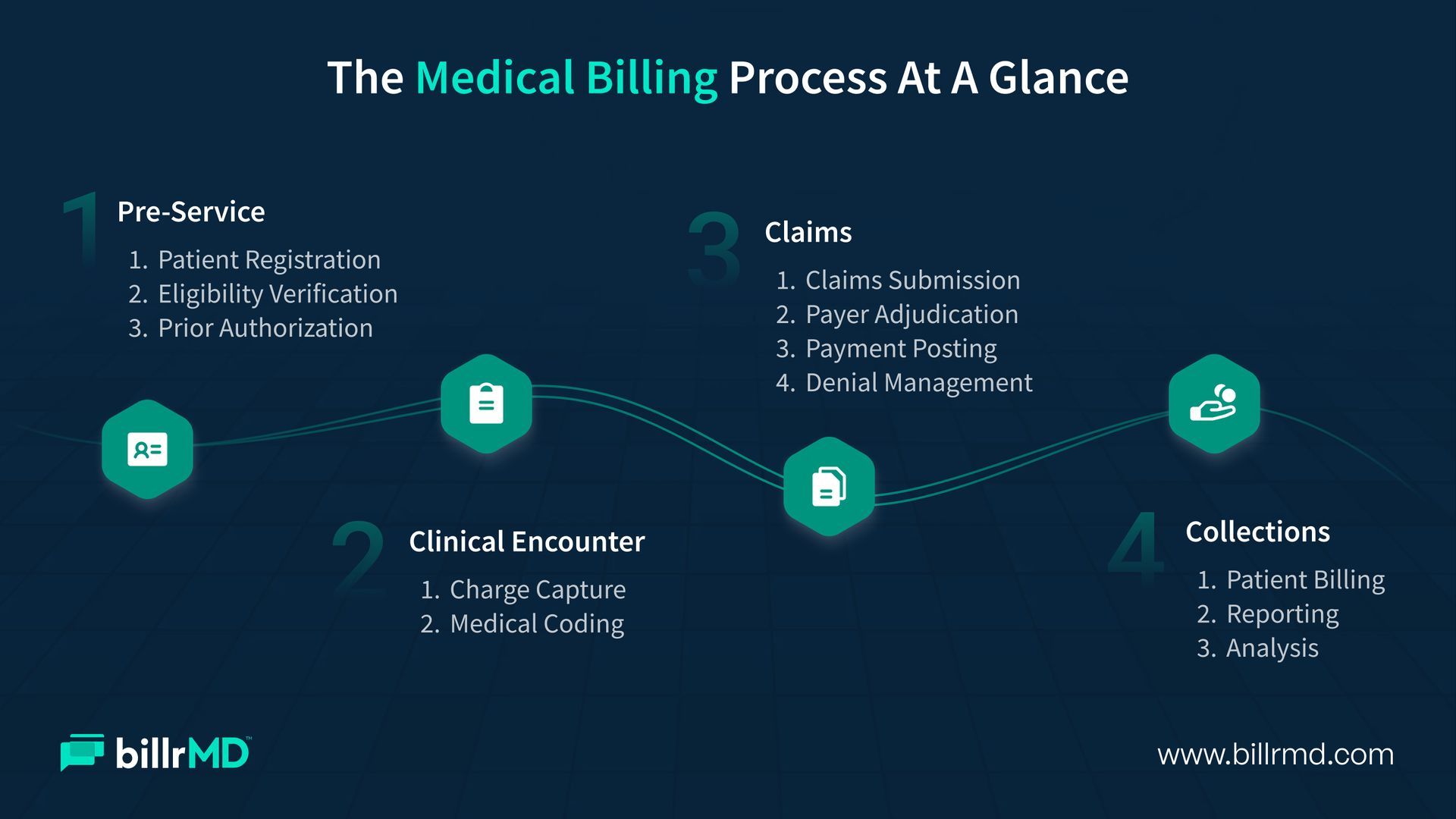
Medical Billing Process Steps
Step 1: Patient Registration
Everything begins here. Before any service is rendered, your front desk team collects the patient's full name, date of birth, address, insurance information, and government-issued ID. This data is the foundation for every claim that follows, which means accuracy at this stage is non-negotiable.
A transposed digit in a policy number or a misspelled name is all it takes to get a claim rejected at submission. Practices using integrated scheduling and billing platforms can validate this information in real time, so discrepancies get caught before they become problems further down the line.
Step 2: Insurance Eligibility Verification
Once a patient is registered, the priority shifts to confirming their coverage. That means verifying the plan is active, understanding what it covers, identifying the patient's deductible and copay obligations, and checking for referral or authorization requirements that may apply.
Real-time eligibility verification is one of the highest-leverage checkpoints in the entire medical billing workflow. It helps catch coverage issues before the patient's appointment, protecting your practice from denials after services have already been provided. Additionally, it helps patients understand their responsibilities before receiving care, making collections much easier.
Step 3: Prior Authorization
Certain procedures, specialist referrals, and medications require pre-approval from the payer before they're performed. Skip this step when it's required, and you're looking at a hard denial: a flat refusal from the payer that rarely gets overturned, regardless of how medically appropriate the service was.
Authorization requirements vary by payer and change frequently. Practices that manage these systematically, tracking what's been requested, approved, and still pending, are far less likely to discover later that a procedure wasn't covered.
Step 4: Charge Capture
After the patient visit, the provider's documentation is converted into a charge that lists the services delivered and their corresponding procedure codes. Charge capture can happen in real time through an EHR or as a separate review step, depending on how the practice operates.
Vague or incomplete clinical notes are one of the most consistent root causes of coding errors and the denials that follow. Clear, specific documentation gives coders what they need to assign the right codes accurately.
Step 5: Medical Coding
The trained coder will then review the encounter documentation and determine the correct ICD-10 diagnosis coding, CPT procedure coding, and any required modifiers. Coding directly affects reimbursement, and coding rules are not static, with new code sets issued annually and individual payers adding their rules on coverage and bundling on top of those rules.
In the medical billing process steps, this is one of the more technically demanding and one of the most common origins of denials when it's not handled carefully. Access to updated code libraries and regular staff training aren't optional here; they're operational requirements.
Step 6: Claims Submission
Once the charges are collected and the codes assigned, the claim is prepared and transmitted to the payer, usually via an electronic clearing house. Electronic claims are much faster, easier to track, and much less prone to errors than their paper counterparts, and the majority of payers require them.
However, before any claim is transmitted, it is important to run it through the claim scrubbing process. Claim scrubbing is the process by which the claim is reviewed automatically to ensure it is accurate, complete, and does not include any codes that payers frequently reject. Good medical billing practice dictates that claim scrubbing is not optional.
Step 7: Payer Adjudication
Once a claim is submitted, it enters the payer's adjudication system for review. The insurance company evaluates the claim against the patient's plan, medical necessity criteria, and payer-specific coverage rules. The result is an approval, a partial payment, an information request, or a denial.
This stage is largely outside your control. But proactively tracking claim status, rather than waiting for an explanation of benefits to show up in the mail, helps your team surface stalled or flagged claims before they age out of the appeal window.
Step 8: Payment Posting
When payment arrives, it needs to be posted accurately to the correct patient account. Electronic remittance advice (ERA) makes this substantially faster by allowing payments to post automatically from the payer rather than being entered manually, line by line.
Accurate payment posting is more than an administrative task. It tells your team exactly what the payer covered, what was adjusted, and what portion remains as a patient balance. That clarity is what drives every step that follows.
Step 9: Denial Management
It should be noted that claims do not always get paid on the first submission. What differentiates practices with a good revenue cycle from those without is how well they handle denials when they occur.
Good denial management is more than simply figuring out the cause of denial for each claim, making the required changes, and then resubmitting the claim within the payer's window for appeal. Good denial management is more about understanding denial patterns over time. If a code, payer, or provider has a history of denial, then there is a process problem.
Knowing how to improve the medical billing process almost always starts here. Denial analysis is the fastest way to find where your revenue is leaking and what to do about it.
Step 10: Patient Billing and Collections
After insurance pays its portion, the remaining balance goes to the patient. With high-deductible health plans now standard across much of the insurance market, patient collections represent a growing share of total practice revenue, and they require just as much attention as payer claims.
Clear, itemized statements, digital delivery options, and simple online payment tools make a measurable difference in how quickly balances get paid. It's also worth remembering that billing is a patient touchpoint. A confusing or delayed statement can undermine the experience of an otherwise well-run visit.
Step 11: Reporting and Analysis
The medical billing process doesn't end with collections. Regular reporting gives billing managers and practice owners the visibility they need to assess cycle performance: denial rates by payer, average days in accounts receivable, collection percentages, and revenue trends over time.
This data is what lets practices shift from reactive to proactive. Identifying a trend early, before it compounds across hundreds of claims, is the difference between a minor workflow adjustment and a significant revenue recovery project.
Benefits of Integrating Medical Billing Software Into Your Process
Understanding the steps is foundational. Having reliable tools to execute them consistently is what translates that knowledge into results. When medical billing software supports the full cycle rather than just one or two stages in isolation, the advantages compound:
- Fewer errors entering the system: Eligibility checks and data validation help identify errors before they become a problem.
- Faster submission turnaround: Electronic processes can reduce the time from patient encounter to claim submission from days to hours.
- Cleaner claims on the first pass: Claim scrubbing helps identify errors in code usage, modifier usage, and formatting before they're ever seen by a payer.
- Full-cycle visibility: Reporting tools provide a live view of billed charges, pending claims, and collection status.
- Less administrative strain on your practice: Automation reduces billing-related tasks, freeing your staff to focus on tasks that truly require a human touch.
The gap between a practice that bills efficiently and one that doesn't usually isn't a staffing problem. It's a connectivity problem. When the EHR, billing platform, scheduling tools, and patient payment systems don't communicate cleanly, that's where revenue slips through.
Why billrMD Fits Into Every Step of the Process
billrMD is a fully web-based billing and practice management platform built to support the entire RCM process in medical billing, from patient registration through final payment posting. There's no software to install, no on-site server to maintain, and no manual update cycle to manage.
The platform includes real-time eligibility verification integrated directly into the scheduling workflow, claim scrubbing on every submission, ERA processing with automatic payment posting, and a code library with over 73,000 ICD-10, CPT, and DSM-5 codes. Configurable reporting dashboards give practice managers clear visibility into denial trends, accounts receivable aging, and overall revenue cycle performance. And the patient invoicing tools allow practices to send branded, itemized statements digitally, helping patients understand and pay their balances faster.
With a 99% first-pass acceptance rate, billrMD gives practices the infrastructure to run a tighter billing cycle at every step, without the complexity of a fragmented multi-platform setup.
Conclusion
The medical billing process is not one task; it is a series of steps. It is important to understand that the accuracy of one step directly affects all subsequent steps. Registration errors cause eligibility issues. Eligibility issues cause a denial risk. Denial risk causes revenue write-off.
Practices that understand this chain and build their workflow around it consistently collect more, faster, and with less administrative friction. Knowing the medical billing process steps, identifying where your current process breaks down, and putting the right tools in place at each stage are the three most practical steps toward a stronger revenue cycle.
billrMD gives practices the platform to do exactly that, without the implementation complexity that tends to slow change down.
Try billrMD for Free
Frequently Asked Questions
What is the medical billing process?
The medical billing process is the sequence of steps healthcare providers follow to submit claims, collect payments, and manage the revenue cycle. It typically includes patient registration, insurance verification, prior authorization, charge capture, coding, claims submission, payer adjudication, payment posting, denial management, patient billing, and financial reporting.
How many steps are in the medical billing process?
Most billing workflows involve 8 to 11 distinct steps, depending on the practice type and the payers involved. The core steps include registration, eligibility verification, medical coding, claim submission, adjudication, payment posting, denial management, and patient billing.
How can I improve my medical billing process?
Denial analysis is the most effective starting point. Identifying the most frequent denial reasons and tracing them back to specific workflow steps is usually the fastest way to find where improvement will have the most impact. Building in claim scrubbing, real-time eligibility checks, and systematic performance reporting creates consistent, measurable gains over time.
How does medical billing software support the billing workflow?
A well-integrated platform supports multiple stages simultaneously: verifying eligibility before appointments, scrubbing claims before submission, automating payment posting through ERA, and surfacing denial patterns through reporting dashboards. The most effective platforms connect the full cycle rather than automating just one or two points in isolation.
Recent Posts