How to Improve Revenue Cycle Management: Strategies, Software, and KPIs

For most medical practices, revenue cycle problems don't announce themselves all at once. They build. A claim comes back denied. Eligibility wasn't confirmed before an appointment. Payments are trickling in slower than expected, but nobody has a clear picture of where things are stalling. By the time the pattern is obvious, the revenue impact has been compounding for months.
Understanding how to improve revenue cycle management isn't just a billing department concern. It affects cash flow, administrative workload, and your practice's financial stability to deliver the quality of care it was built to provide. This guide covers the most common obstacles, the strategies that actually move the needle, and how medical practice management software and revenue cycle management tools change the picture for practices that are serious about financial performance.
Run Your Practice Efficiently
What Revenue Cycle Management Actually Covers
Revenue cycle management (RCM) is the process of tracking and collecting payment for every service your practice delivers. It starts the moment a patient contacts your office and ends when the final payment clears, whether that comes from the payer, the patient, or both.
The steps in between include patient registration, insurance eligibility verification, charge capture, coding, claim submission, payment posting, denial management, and patient collections. Each one is a place where something can go right or wrong, and the cumulative effect of small inefficiencies across that chain adds up quickly. Practices that understand the medical billing process end-to-end have a real advantage in identifying where to focus improvement efforts first.
Top Healthcare Revenue Cycle Challenges
The top healthcare revenue cycle challenges cluster around the same handful of problems regardless of specialty or practice size.
- Coding errors and claim denials are among the most costly. Research published in the National Library of Medicine found that roughly 1 in 4 claim denials from primary care office visits are attributable to coding errors alone. For practices managing high patient volumes, that's a significant and ongoing revenue leak.
- Eligibility surprises are another persistent source of friction. When a patient's coverage isn't verified before their appointment, billing complications surface afterward. It slows collections and puts stress on the patient relationship at exactly the wrong moment.
- Manual data entry increases the risk of errors throughout the revenue cycle. Staff entering information between systems that don't communicate or re-keying charge data from paper documents creates errors that lead to rejections and rework.
- Fragmented systems are often the root cause behind many of these problems. When scheduling, clinical documentation, and billing run on separate platforms, data must be transferred manually between them. That movement creates gaps, delays, and a loss of visibility into where your revenue actually stands.
- Slow or inconsistent follow-up on denials compounds everything. Practices without a structured denial management workflow often let recoverable claims go unpursued, not because staff aren't working hard, but because there's no system to flag them reliably.
How to Improve Revenue Cycle Management: Core Strategies
The answer to ‘how to improve revenue cycle’ performance starts with identifying where breakdowns occur and applying targeted fixes. These strategies apply whether you're working toward optimization or starting a more significant overhaul.
Verify eligibility before every appointment
Real-time eligibility verification prevents coverage surprises that lead to billing complications later. Leading practices increasingly automate eligibility verification before scheduled visits.
Submit clean claims the first time
A clean claim contains accurate coding, complete documentation, and meets the payer's specific submission requirements. Every clean claim that goes out reduces the time your team spends on corrections, appeals, and follow-up.
Build a structured denial management workflow
Denied claims aren't automatically lost revenue, but they require consistent follow-up to recover. A defined workflow for identifying, categorizing, and appealing denials is one of the highest-return improvements most practices can make.
Standardize charge capture
Charge capture errors, whether from missed codes, incorrect modifiers, or documentation gaps, directly reduce what you collect. Structured processes supported by software that validates entries before submission close this gap.
Track performance with real data
Practices that don't measure their revenue cycle performance can't improve it systematically. Reviewing key metrics on a regular cadence turns reactive problem-solving into proactive management.
How Medical Practice Management Software Improves Revenue Cycle Management
Medical practice management software has transformed revenue cycle management by enhancing speed, accuracy, visibility, and scalability. By integrating scheduling, billing, and reporting into a single platform, data flows seamlessly without manual intervention.
Appointments are linked directly to eligibility verification, clinical encounters flow into charge capture, and claims are automatically checked against payer rules. This integration reduces handoff errors in manual workflows and provides your team with a unified view of the status of every claim throughout the cycle.
For practices evaluating the best software for healthcare revenue cycle improvement, the most important capabilities to look for are real-time eligibility verification, automated claim scrubbing, electronic remittance advice, denial tracking, and reporting tools that surface the metrics your team can act on. The platform should be web-based, meaning no server maintenance, no manual updates, and access from wherever your team works.
Reduce Claim Denials with Software
Claim denials signal issues in the revenue cycle process. Software designed to prevent errors addresses these problems upfront. billrMD's electronic claims submission uses a scrubbing engine to validate claims against over 73,000 ICD-10, CPT, and DSM-5 codes before submission, flagging errors to reduce rejections and rework. This results in a 99% first-pass acceptance rate, minimizing the time and cash flow gaps associated with denied claims.
Additionally,
Electronic Remittance Advice (ERA) automates payment posting, improving accuracy and speeding up the process. With real-time eligibility verification before appointments, your team can identify coverage issues early, preventing billing complications.
Revenue Cycle KPIs to Track
Improving revenue cycle management requires knowing which numbers actually reflect performance. These are the metrics that give you the clearest and most actionable picture.
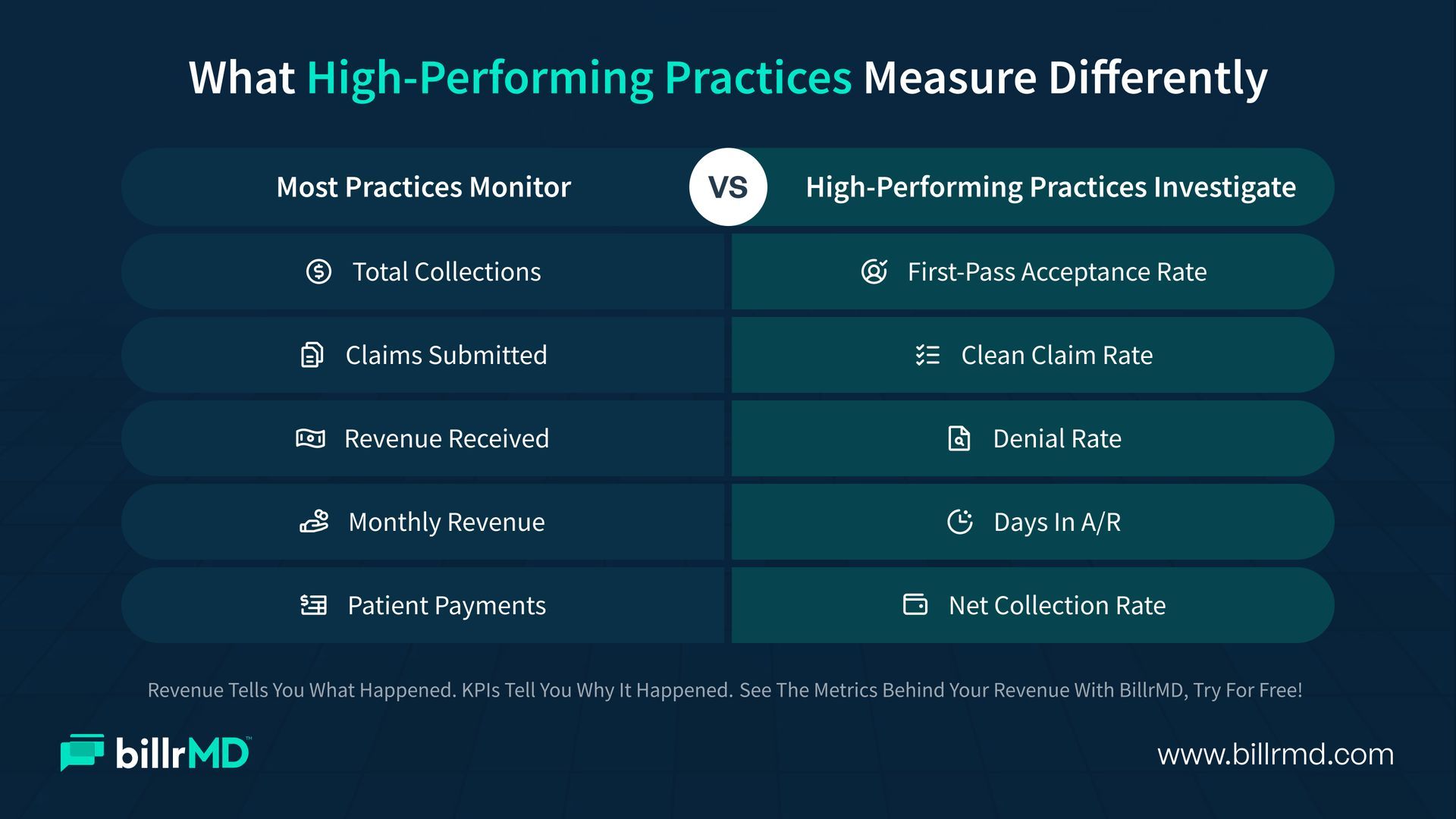
Days in Accounts Receivable (A/R) measures the average time it takes to collect payment after a service is delivered. Many practices aim to keep Days in A/R as low as possible, often targeting 30–40 days depending on specialty and payer mix. A rising number signals that something in the cycle is creating unnecessary delay.
First-Pass Acceptance Rate is the percentage of claims accepted by the payer on the first submission. A high rate is a direct indicator of clean claim quality and coding accuracy. It's also one of the most meaningful measures of how well your billing process is working.
Claim Denial Rate tracks the percentage of submitted claims that are denied. Monitoring this over time, broken down by denial, reveals exactly where your process needs attention.
Net Collection Rate measures the percentage of collectible revenue your practice actually receives after contractual adjustments. It's the most honest indicator of overall billing effectiveness.
Clean Claim Rate
reflects the percentage of claims that go out without errors before the payer even reviews them. Practices with a high clean claim rate spend significantly less time on rework.
billrMD's reporting and analytics tools surface all of these metrics from a single dashboard, so your team isn't pulling reports manually or stitching together data from multiple systems.
Revenue Cycle Efficiency Best Practices
Review denial patterns regularly, not just denial totals. A 5% denial rate looks manageable until you realize half of those denials share the same root cause. One process change can close a problem that's been quietly costing you revenue for months.
Automate what can be automated. Eligibility checks, claim scrubbing, payment posting, and patient statement delivery are all strong candidates. The more your team's time is freed from repetitive tasks, the more capacity they have for work that requires real judgment.
Verify patient demographic and insurance information at every visit, not just the first. Policies change, coverage lapses, and contact information goes stale. A brief verification step at check-in prevents significant downstream complications.
Establish a denial follow-up timeline. Unworked denials don't age well. A clear policy for how quickly denials are reviewed and appealed protects recoverable revenue from slipping past timely filing deadlines.
Use your reporting tools proactively. The practices that improve fastest are the ones that review performance data regularly, identify trends before they compound, and adjust before a pattern becomes a persistent problem.
Why billrMD
billrMD is a web-based medical practice management software and billing platform that simplifies the revenue cycle without needing servers or complex setups. Its claim scrubbing engine can lead to a 99% first-pass acceptance rate by validating submissions against over 73,000 codes and payer rules. It includes real-time eligibility verification, payment posting, and customizable patient invoicing in one integrated workflow.
With reporting tools for denial trends and performance metrics, billrMD adapts to in-house or external billing processes seamlessly. It’s ideal for practices seeking streamlined management.
See the Difference for Yourself
Frequently Asked Questions
How does practice management software improve revenue cycle management?
It integrates scheduling, billing, and reporting into a single system, eliminating manual data transfers that cause errors and delays. Automated eligibility checks, claim scrubbing, and ERA-powered payment posting each address specific points where revenue is typically lost without software support.
What KPIs should I track to measure revenue cycle performance?
The most actionable metrics are days in A/R, first-pass acceptance rate, claim denial rate, net collection rate, and clean claim rate. Tracking these over time shows where your cycle is performing well and where it needs attention.
Can improving revenue cycle management actually improve patient care?
Yes. A well-managed revenue cycle reduces billing errors and unexpected patient charges, which improves the patient experience around billing. It also gives the practice financial stability to invest in staff and resources that directly support clinical care.
What should I look for when evaluating software for revenue cycle improvement?
Start with real-time eligibility verification, automated claim scrubbing, electronic remittance advice, denial tracking, and robust reporting. The platform should be web-based, scalable, and integrate scheduling and billing without requiring separate tools for each function.
Recent Posts