What Is Claims Management in Healthcare? A Complete Process and Software Guide

A single denied claim rarely feels like a crisis. It's the accumulation that hurts. Recent industry research found that 41% of providers now report denial rates of 10% or higher, and 68% say submitting clean claims has gotten harder over the past year, not easier. If your billing team is spending more time on rework than on the next patient encounter, the problem usually isn't a lack of effort. It's infrastructure.
This guide breaks down what healthcare claims management actually involves and how practice management systems handle it. It also discusses where the process tends to break down and what a modern healthcare claims management software platform should be doing for your practice.
Fewer Claim Denials With billrMD
What Is Claims Management in the Healthcare Sector?
Claims management in healthcare involves processes that turn patient encounters into paid claims, from patient registration through adjudication, payment posting, and denial resolution. Key elements include eligibility verification, coding accuracy, claim scrubbing, submission, payer follow-up, and denial resolution, forming a continuous cycle.
Healthcare claims management software automates these tasks, eliminating the need for manual tracking through spreadsheets and phone calls. Instead, it provides a real-time view of claim statuses and flags potential issues before they lead to denials. Most often, this software is integrated into broader practice management systems that also manage scheduling and patient records.
Standalone tools that don’t integrate with EHR or scheduling systems can create fragmentation, which contributes to
claims denials when insurance information changes without the billing system’s knowledge.
How Practice Management Systems Handle Claims Submission
The claim submission process in a modern practice management system follows a consistent sequence. After documenting and coding a visit, the system compiles the patient's demographic and insurance information with diagnosis and procedure codes. An automated scrubbing process checks the claim against payer-specific rules for any errors before submission.
Claims are then transmitted electronically through a clearinghouse to the appropriate payer. This is where insurance claims processing shifts from your practice's hands into the payer's adjudication system.
A well-designed platform continues to track the claim’s status in real time, flagging any stalls and alerting the team to denials promptly for timely action.
In contrast, practices that use paper claims or manual entries lose this visibility, often discovering denials weeks later, when it's harder to resolve them.
Common Challenges in Claims Processing
Even well-run practices run into the same recurring problems in the medical claims process, and the data backs up what most billing teams already feel day to day.
Rising denial rates
Denials aren't just holding steady; they're climbing. According to a survey reported by Fierce Healthcare, 11% of providers said 15% of their claims are denied. This number raises concerns and requires attention from healthcare leaders.
Eligibility and registration errors
A single transposed policy number or an outdated insurance card can trigger a hard denial before the claim ever reaches the coding stage. These front-end errors are among the most preventable and among the most common.
Coding and documentation gaps
Vague clinical notes make it harder for coders to assign accurate codes, and coding rules shift every year. A mismatch between documentation and billed codes is one of the most consistent denial triggers across specialties.
Slow, manual follow-up
When denials do occur, the cost compounds. Recent audit data showed hospital outpatient and inpatient denial amounts rising 14 percent and 12 percent, respectively, in a single year, with payer audit activity increasing alongside it (Source: Fierce Healthcare). Practices without systematic denial tracking often don't catch the pattern until it's cost them thousands of dollars across dozens of claims.
Fragmented technology
When scheduling, EHR, and billing don't share data automatically, staff spend hours manually transferring information between systems. That's hours not spent on patients, and it's where many preventable errors creep in.
Key Features of a PM System for Claims Management
Not every practice management system handles claims the same way. When evaluating claims processing software, a few features consistently separate platforms that reduce denials from those that merely digitize the same problems.
Real-time eligibility verification
Confirming active coverage before the appointment, not after, prevents one of the most common and avoidable denial categories.
Automated claim scrubbing
Every claim should be checked against payer rules before submission to automatically catch missing fields, invalid codes, and unsupported modifiers.
A large, current code library
Coding rules change constantly. A platform with an extensive, regularly updated ICD-10, CPT, and modifier database reduces coders' chances of making errors that the system should have caught.
Electronic remittance advice (ERA) integration
Automated payment posting from payers eliminates manual line-by-line entry and gives your team an accurate, current view of what's been paid and what's outstanding.
Denial and reporting dashboards
Practices need visibility into denial trends by payer and code, accounts receivable aging, and collection rates, all without pulling data from three different places.
Both electronic and paper submission support
Most claims should go out electronically, but some payers and situations still require paper. A platform that handles both without forcing a workaround saves your team a separate process.
How Automated Claims Processing Works
Automated claims processing replaces the manual checkpoints in the billing cycle with system-driven logic, and the financial case for it is stronger than most practices realize. The 2025 CAQH Index found that electronic healthcare transactions cost an average of $3.39, compared to $8.03 for the equivalent manual process, with roughly $18.7 billion in additional savings in the medical industry still available through wider adoption of automation.
In practice, this looks like a claim being scrubbed against payer rules the moment it's generated, rather than being reviewed by a person after the fact. It looks like when the eligibility checks are running automatically ahead of a scheduled visit, instead of a staff member calling the payer. It looks like a remittance file posting payments to the correct patient account the moment it's received, instead of someone manually reconciling an explanation of benefits line by line.
Automated claims processing software doesn't remove your billing team from the equation. It removes the repetitive, rules-based work so your team's time goes toward the claims and denials that actually require judgment, not the ones a computer could have caught in the first place.
Benefits of Using a PM System for Claims Management
The case for investing in claims management solutions goes beyond fewer denials, though that's usually where the conversation starts.
Faster reimbursement
Cleaner claims move through adjudication faster, and automated payment posting shortens the gap between service delivery and cash in hand.
Lower administrative overhead
Automation handles the repetitive parts of the cycle, freeing staff to focus on exceptions, appeals, and patient communication rather than data entry.
Better financial visibility
Real-time dashboards mean practice leaders aren't discovering a revenue problem weeks after it starts. Denial trends and aging reports surface issues before it's too late to act.
Scalability without proportional staffing costs
A well-built system absorbs added claim volume from new providers or locations without requiring your billing team to grow at the same rate.
Reduced compliance risk
Payer rules and coding standards change constantly. A platform that stays up to date automatically takes that burden off your team.
How to Improve Your Clean Claim Rate
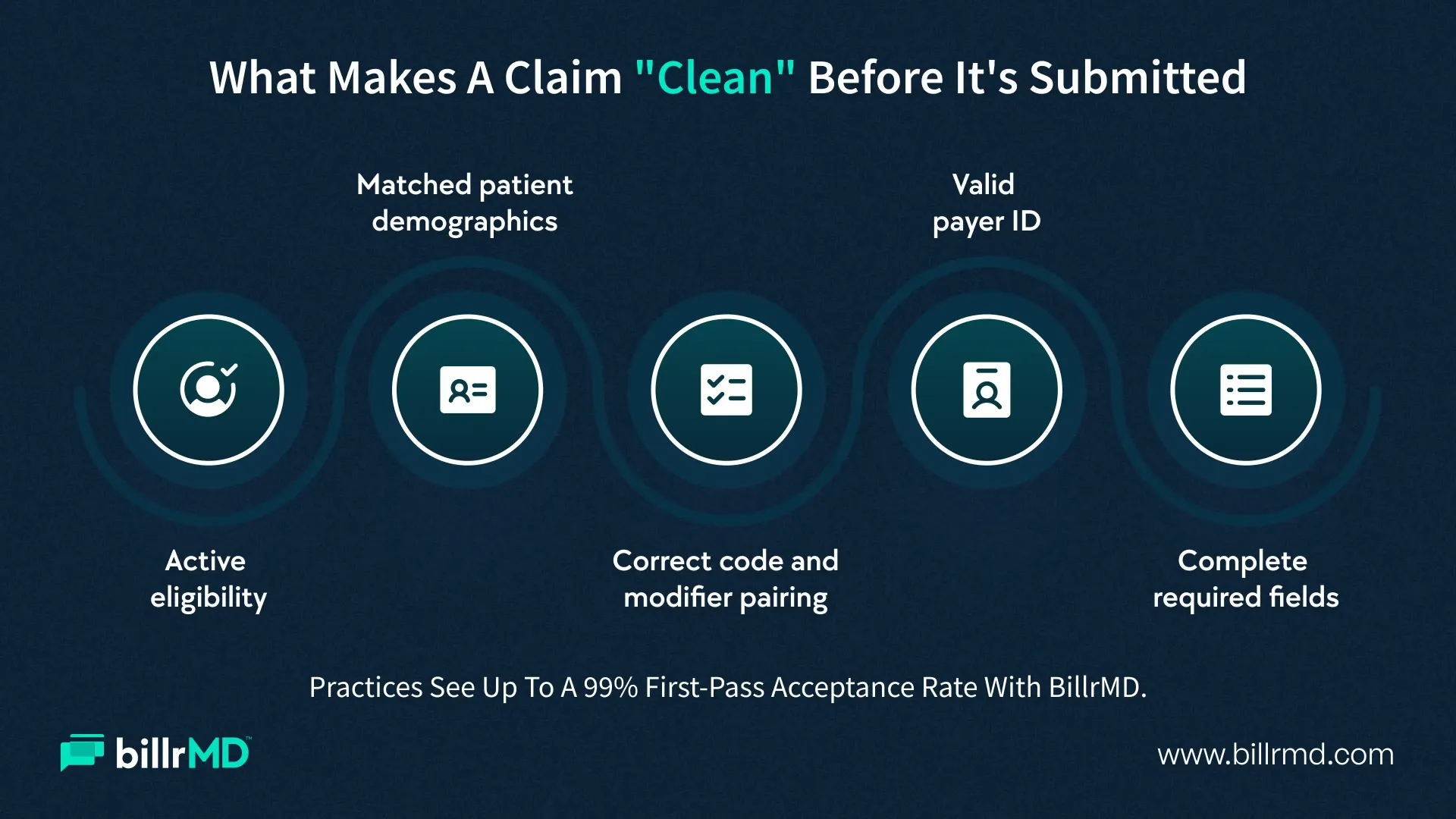
A high clean claim rate, meaning the percentage of claims accepted on first submission without edits, is one of the clearest indicators of a healthy billing operation. A few practices consistently move the needle:
- Verifying eligibility before every visit rather than assuming coverage hasn't changed
- Keeping coder training current as payer rules shift
- Running every claim through automated scrubbing before submission
- Reviewing denial patterns monthly rather than only when a specific claim causes a problem
Why billrMD
billrMD is a web-based practice management and medical billing platform designed to streamline the entire claims cycle. With no installations or server maintenance required, it boasts up to a 99% first-pass acceptance rate thanks to its claim scrubbing engine, which verifies submissions against over 73,000 ICD-10, CPT, and DSM-5 codes.
Real-time eligibility verification is integrated into the scheduling workflow, and electronic remittance advice automates payments. billrMD connects to various payers through multiple clearinghouses for efficient claims submission.
Its reporting and analytics tools allow users to identify denial trends, monitor accounts receivable aging, and assess collection performance from a single dashboard, making it suitable for both lean teams and growing multi-provider practices.
Conclusion
Claims management in healthcare isn't a single task; it's a chain of steps where an early error creates a bigger problem downstream. Registration mistakes cause eligibility issues. Eligibility issues raise denial risk. Denial risk results in lost or delayed revenue. Practices that treat the claims cycle as a connected system, backed by software that automates the repetitive parts and surfaces problems early, consistently collect more with less friction.
The right healthcare claims management software doesn't just process claims faster. It gives your team the visibility to catch problems before they cost you, and the infrastructure to keep up as your practice grows.
See billrMD in Action
Frequently Asked Questions
What is claims management in healthcare?
Claims management in healthcare is the process of preparing, submitting, tracking, and resolving healthcare claims so providers get paid for the care they deliver. It spans eligibility verification, coding, claim submission, payer adjudication, payment posting, and denial resolution.
What's the difference between claims management software and a full practice management system?
Claims management software typically focuses specifically on the billing and claims cycle. A practice management system covers that plus scheduling, patient records, and broader administrative functions. Many modern platforms, including billrMD, combine both, so claims data flows directly from clinical and scheduling activity rather than requiring separate systems.
How does automated claims processing reduce denials?
Automation catches errors before a claim is ever submitted by checking it against payer-specific rules, verifying eligibility ahead of appointments, and flagging missing or mismatched information. This shifts error detection from after a payer rejection to before submission, which is significantly faster and less costly to fix.
How do I know if my practice needs new claims management software?
Signs include a clean claim rate that's declining or unclear, staff spending significant time on manual data entry between disconnected systems, denial patterns you can't easily trace to a root cause, or a billing team that's outgrown what your current platform can report on.
Recent Posts