How to Improve Your Revenue Cycle Management: 9 Actionable Steps for 2026

Revenue cycle management determines whether your practice gets paid for the care it already delivered. In 2026, that job has gotten tricky. Prior authorization still consumes significant staff time, while practices deal with complex payer requirements and avoidable claim denials. For practices still running on manual workflows or disconnected systems, the gap between care delivered and revenue collected keeps widening.
It's likely that a complete overhaul isn't necessary for effectively improving revenue cycle management. Start with the places where errors and delays keep repeating. Many practices can improve performance by tightening a few high-impact processes and using technology to reduce manual work. Here's how to improve revenue cycle management in nine actionable steps, plus how the right practice management platform ties it all together.
Sign Up Without a Credit Card
Why Revenue Cycle Management Matters in 2026
Revenue cycle management touches every financial interaction between your practice and a patient, from the moment an appointment is booked to the day the final balance is paid. When any part of that chain breaks, cash flow suffers, staff burn out chasing rework, and patients get stuck in billing confusion.
The administrative workload isn't getting any easier. Prior authorization remains one of the biggest burdens reported by medical practices. A report found that
92% of medical group practices reported hiring or reassigning staff specifically to manage growing PA volume. Add in climbing denial rates and shrinking staff bandwidth, and it's clear that revenue cycle management process improvement isn't optional anymore.
If you're still working through the fundamentals, our guide to what
revenue cycle management involves is a good starting point before diving into these steps.
Steps to Improve Your Revenue Cycle Management
Here are nine actionable steps you can follow to give a boost to your collections and make sure gaps in revenue cycles are eliminated:
1. Verify Insurance Eligibility Before Every Visit
Eligibility problems are a common source of avoidable claim issues. Confirm coverage, plan details, and prior authorization requirements before the patient walks in to stop a denial before it starts. Run real-time eligibility checks during scheduling and again before the visit when your workflow allows it. This can catch coverage changes before they turn into billing problems. This single habit change often produces the fastest visible gains in improving revenue cycle management.
2. Tighten Upfront Patient Registration and Data Collection
A single typo in a policy number or date of birth can send a clean claim straight to a denial. Standardize your intake process, double-check demographic and insurance fields, and train front desk staff to flag anything that looks off before the visit is even scheduled. Accurate front-end data saves hours of rework later, and it's one of the simplest ways to improve revenue cycle management without adding headcount.
3. Strengthen Coding Accuracy and Documentation
Coding errors and incomplete documentation remain leading denial triggers, especially as payers use more automated claim reviews. Keep coders current on payer-specific rules and CPT and ICD-10 updates, and build a quick feedback loop between coding and clinical documentation so you catch gaps before submission, not after a denial arrives.
4. Automate Claims Scrubbing Before Submission
Manual claim review can't keep pace with rising claim volume. Automated
claims scrubbing checks claims for common errors before submission, such as missing information, coding mismatches, or modifier issues. Catching those issues before submission can improve first-pass acceptance and reduce rework from rejected or denied claims.
5. Streamline Prior Authorization Workflows
Prior authorization has become one of the biggest drains on staff time in medical practices. Build a repeatable process for tracking PA status, deadlines, and payer-specific requirements, so requests don't fall through the cracks. Where possible, use software that flags PA requirements automatically at scheduling rather than relying on staff memory alone.
6. Build a Proactive Denial Management Process
Most practices handle denials reactively, working them one by one as they arrive. A stronger approach tracks denial patterns by payer, code, and reason, so you can fix the root cause instead of resubmitting the same claim type every month. Our guide to
denial management best practices breaks down how to build that process step by step.
7. Track RCM KPIs With Real-Time Reporting
Before you change the process, make sure you know where the money is getting stuck. Days in accounts receivable, first-pass acceptance rate, denial rate by payer, and net collection rate are the numbers that show where your revenue cycle is breaking down. Real-time
reporting and analytics turn these metrics from a monthly surprise into something your team can act on weekly. Automation is helping close this gap industry-wide: roughly
half of healthcare organizations report they've already deployed AI-driven tools in mid-cycle workflows like coding and denials management, according to research.
8. Simplify Patient Billing and Collections
Patients may still have significant balances after insurance pays, and unclear statements can make those balances harder to collect. Offer clear, branded invoices, multiple payment channels, and online payment options that post directly to the account. A smoother patient billing experience doesn't just improve collections; it protects the patient relationship too.
9. Choose Software That Connects the Revenue Cycle
Even a good RCM process can break down when the software behind it is outdated or disconnected. A connected practice management system can bring scheduling, billing, claims, reporting, and patient payments into one workflow. This reduces the handoffs where information can get lost, or errors can creep in. When you're evaluating top medical practice management software, look for real-time eligibility checks, built-in claims scrubbing, and reporting that updates as claims move through the cycle. billrMD's
practice management platform is built around exactly this kind of connected workflow.
How billrMD Supports a Stronger Revenue Cycle
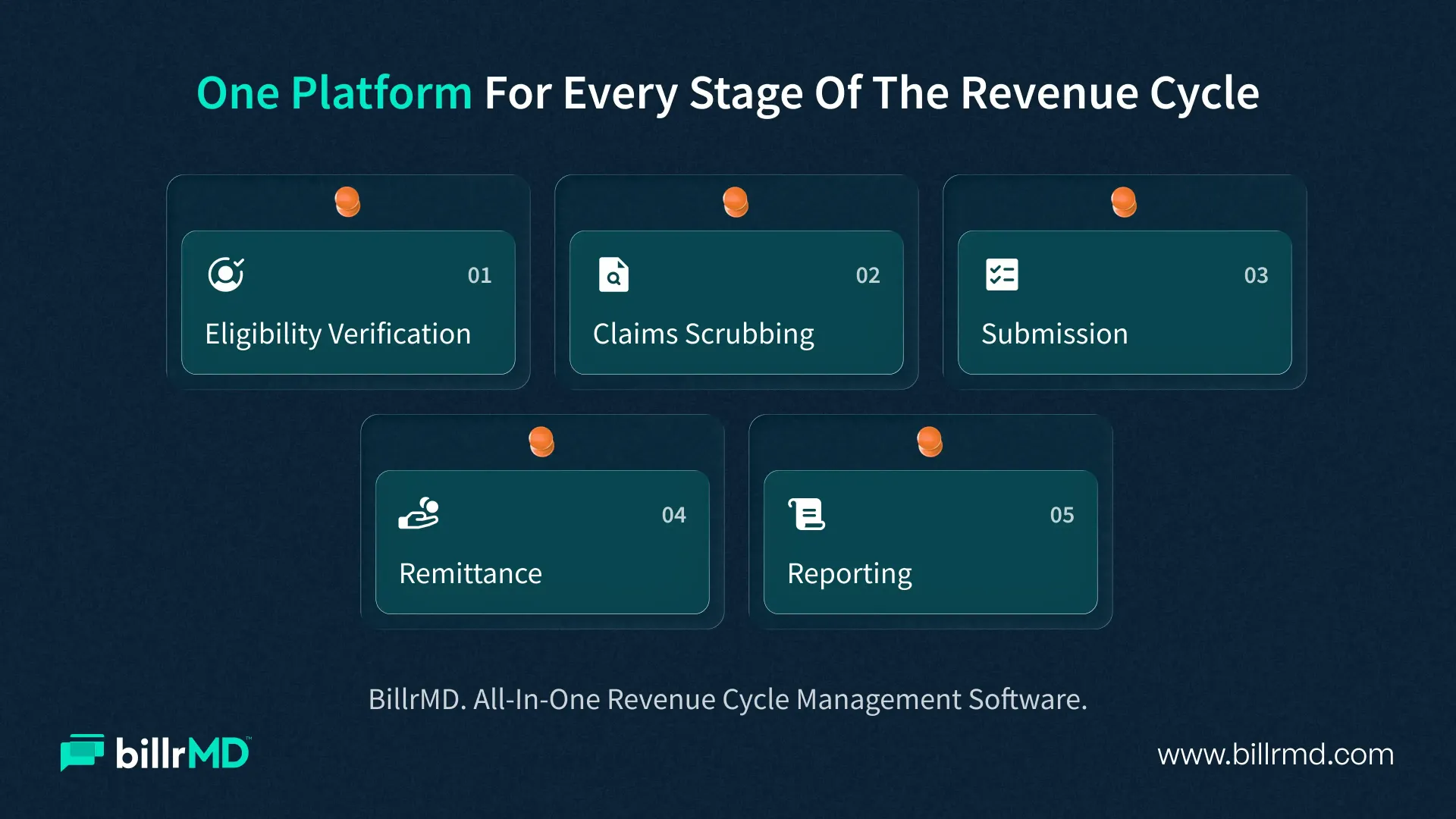
billrMD brings every step above into a single, cloud-based platform built for medical practices, billing companies, and labs. Real-time eligibility verification and integrated claims scrubbing catch errors before they become denials. Electronic claims submission runs through a connected clearinghouse, while electronic remittance advice simplifies reconciliation as soon as a payer responds. Customizable reporting gives practices visibility into denial trends, accounts receivable, and payer performance without piecing information together across multiple systems. On the patient side, billrMD's text or email-to-pay options and patient portal give patients a simpler way to view and pay their balances. For practices comparing top practice management software options, offers all of this in one place, with a free plan to get started.
Conclusion
Improving revenue cycle management in 2026 isn't about one big fix. It's a series of smaller, deliberate changes: verifying eligibility earlier, catching coding errors before submission, tracking denials by root cause, and giving your team visibility into where revenue is getting stuck. Put these steps into practice and give your team the tools they need. The goal is straightforward: catch problems earlier, reduce avoidable rework, and keep claims moving.
Completely Free to Start
Frequently Asked Questions
What is the fastest way to improve revenue cycle management?
Start by identifying where avoidable problems enter your revenue cycle. Eligibility verification and claims scrubbing are two practical places to begin because they can catch issues before submission.
How often should a practice review its RCM performance?
No single cadence works for every practice. At minimum, review core RCM metrics regularly, and consider weekly reviews for measures such as denial rate and accounts receivable when your reporting supports it.
Can small practices benefit from RCM software as much as large ones?
Yes. Smaller practices can benefit significantly from automation because they often have fewer people available to handle billing, follow-ups, and administrative work.
Does billrMD work for billing companies as well as individual practices?
Yes. billrMD supports medical practices, billing companies, laboratories, and IDTFs on the same platform. Billing companies can also use the same software as the practices they serve, helping keep workflows and data in one place.
Recent Posts