10 Common Medical Billing Denial Reasons Every Independent Practice Should Know

Denials and appeals remain a major source of revenue cycle leakage, along with front-end issues, billing and collections, and coding. So naturally, denial management in medical billing becomes crucial to keep your practice’s financial health in check. Understanding common denials in medical billing is the first step toward fixing the issue.
This guide breaks down the top 10 denials in medical billing. It’ll show you how to identify each denial reason and outline practical steps to reduce medical billing denials before they hit your bottom line.
Send out Clean Claims
Top 10 Denial Reasons in Medical Billing
Medical billing denials come in many forms, but some are more common and easy to fix with proper oversight. Here are the top reasons a claim gets denied:
1. Missing or Inaccurate Patient Information
A misspelled name, wrong date of birth, or transposed policy number can send a clean claim straight to the denial pile. These errors usually start at registration and are among the most preventable and common reasons for medical claim denials.
2. Eligibility and Coverage Issues
Coverage can lapse or change without your front desk knowing. Submitting a claim against inactive insurance or an unverified plan is one of the surest paths leading to a denial.
3. Missing or Invalid Prior Authorization
Services performed without the required authorization, or with an authorization number missing from the claim, get rejected almost automatically. Payers have
tightened these reviews significantly in 2025.
4. Coding Errors
Outdated CPT or ICD-10 codes, mismatched diagnosis and procedure pairings, and incorrect modifiers remain a persistent source of types of denials in medical billing. A single wrong digit can invalidate an otherwise accurate claim.
5. Lack of Medical Necessity Documentation
When the documented diagnosis does not clearly support the billed service, payers deny the claim on medical necessity grounds. This is one of the hardest denial types to overturn on appeal.
6. Duplicate Claim Submission
Resubmitting a claim without first checking its current status creates a duplicate, which payers flag and deny. This wastes staff time on a claim that may have already been processed correctly.
7. Timely Filing Limit Exceeded
Every payer sets a deadline for claim submission. Miss it, even by a day, and the claim is denied with little chance of appeal regardless of how accurate it is.
8. Non-Covered or Excluded Services
Some services simply fall outside a patient's plan benefits. Verifying coverage details before the appointment helps avoid billing for something the payer was never going to pay.
9. Bundling and Unbundling Errors
Billing separately for services that a payer considers part of a global package violates
National Correct Coding Initiative edits and triggers a denial. Modifier misuse often compounds this problem.
10. Incomplete or Missing Documentation
Missing signatures, referral letters, or records requested during a payer review can stall an otherwise clean claim indefinitely until you close the gap.
How to Identify and Address Claim Denials
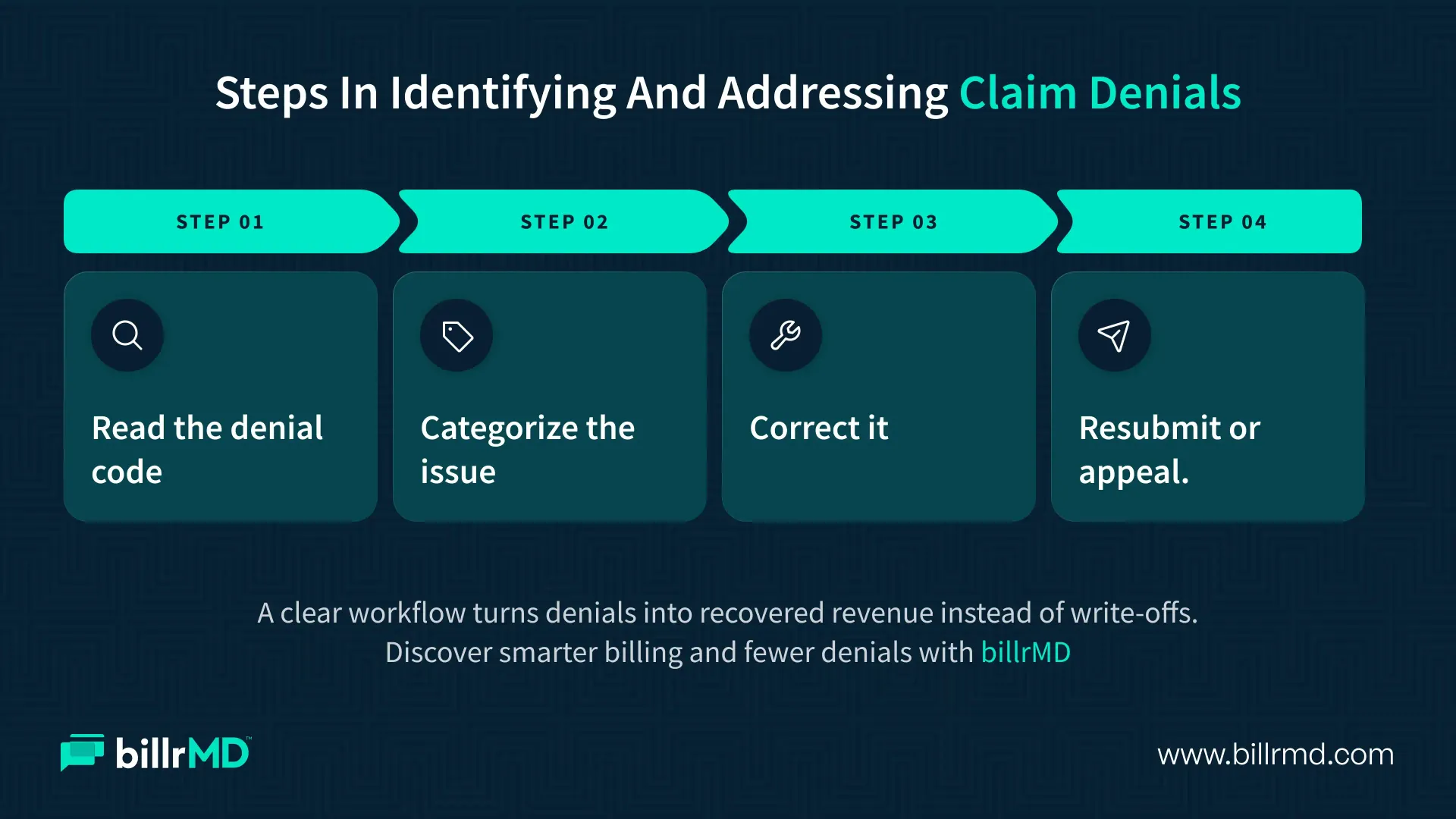
Every denial arrives with a claim adjustment reason code (CARC) and often a remittance advice remark code (RARC) on the explanation of benefits or electronic remittance advice. Reading these codes correctly is the fastest way to route a denial to the right fix.
Start by categorizing denials into buckets: registration, eligibility, authorization, coding, and documentation. This turns a pile of individual problems into a pattern you can actually manage. billrMD's denial management tools automatically sort denials by reason code, so staff can see exactly what needs attention instead of digging through payer portals one claim at a time.
Once a denial is categorized, confirm whether it is correctable and resubmittable, or whether it needs a formal appeal. Track the turnaround time on both, since slow resubmission is often as costly as the original denial.
Strategies to Prevent Recurring Billing Denials
Recurring denials point to a process gap, not bad luck. Start with real-time eligibility verification at scheduling and check-in, so coverage problems surface before the visit instead of after the claim is filed.
Keep authorization and referral tracking centralized so nothing slips through when a service requires prior approval. Standardize documentation templates for high-denial services like imaging and injections, and train coders regularly on payer-specific coding updates.
Finally, review your denial data monthly, not quarterly. billrMD's
reporting and analytics surface denial trends by payer and reason, so a rising pattern gets addressed while it is still preventable.
Best Practices for Improving Clean Claim Rates
You can achieve a high clean claim rate before you submit a claim. Real-time claims scrubbing catches missing fields, invalid codes, and mismatched modifiers automatically, well before a payer ever sees the claim.
Pair scrubbing with automated eligibility checks and authorization tracking so front-end errors do not carry through to billing. Route flagged claims back to staff for correction with a clear explanation of what needs fixing, not just a rejection notice.
Practices that combine these steps consistently outperform the industry benchmark. Average clinical initial denial rates rose to
2.6% in 2025, largely due to missing prior authorizations and unclear medical necessity documentation. This is exactly the type of gap a structured pre-submission process closes.
How billrMD Helps Reduce Denials in Medical Billing
Manually chasing denials pulls staff away from patient care and practice growth. billrMD's medical billing software builds prevention into the workflow instead of treating denial management as a knee-jerk reaction.
With billrMD, practices get real-time claim scrubbing that checks for errors before submission, an integrated clearinghouse for electronic claims, and automatic eligibility verification. Authorization and referral tracking keeps prior approvals organized, while automated denial categorization sorts rejected claims by reason code the moment they arrive.
Custom reports and real-time analytics give your team visibility into denial patterns by payer, so you can fix the root cause instead of reworking the same claim type every month. Read more about how billrMD approaches comprehensive denial prevention.
Conclusion
Claim denials are rarely random. They trace back to a handful of preventable gaps in registration, authorization, coding, and documentation. Fixing those gaps takes the right combination of process discipline and software that catches errors before they cost you revenue. The best part? billrMD is free to start and scales as you grow, so you can trust evidence instead of promises.
Prevent Denials Before They Start
Frequently Asked Questions
What is denial management in medical billing?
Denial management is the process of identifying why claims are denied, correcting the underlying issue, and resubmitting or appealing the claim to recover revenue.
What are the most common reasons for medical claim denials?
Missing patient information, eligibility issues, missing prior authorization, coding errors, and incomplete documentation account for most medical billing denials.
How can a practice lower its overall denial rate?
Verify eligibility before every visit, track authorizations centrally, scrub claims before submission, and review denial data monthly to catch patterns early.
How does billrMD help with denial management in medical billing?
billrMD combines real-time claim scrubbing, eligibility verification, authorization tracking, and denial categorization by reason code into one platform. So practices catch errors before submission and fix root causes faster.
Recent Posts