Medical Billing Checklist for 2027: What to Fix Before the New Year

The first week of January shows whether year-end planning worked. Claims go out, and denials either stay low or start climbing. Most of that outcome gets decided now.
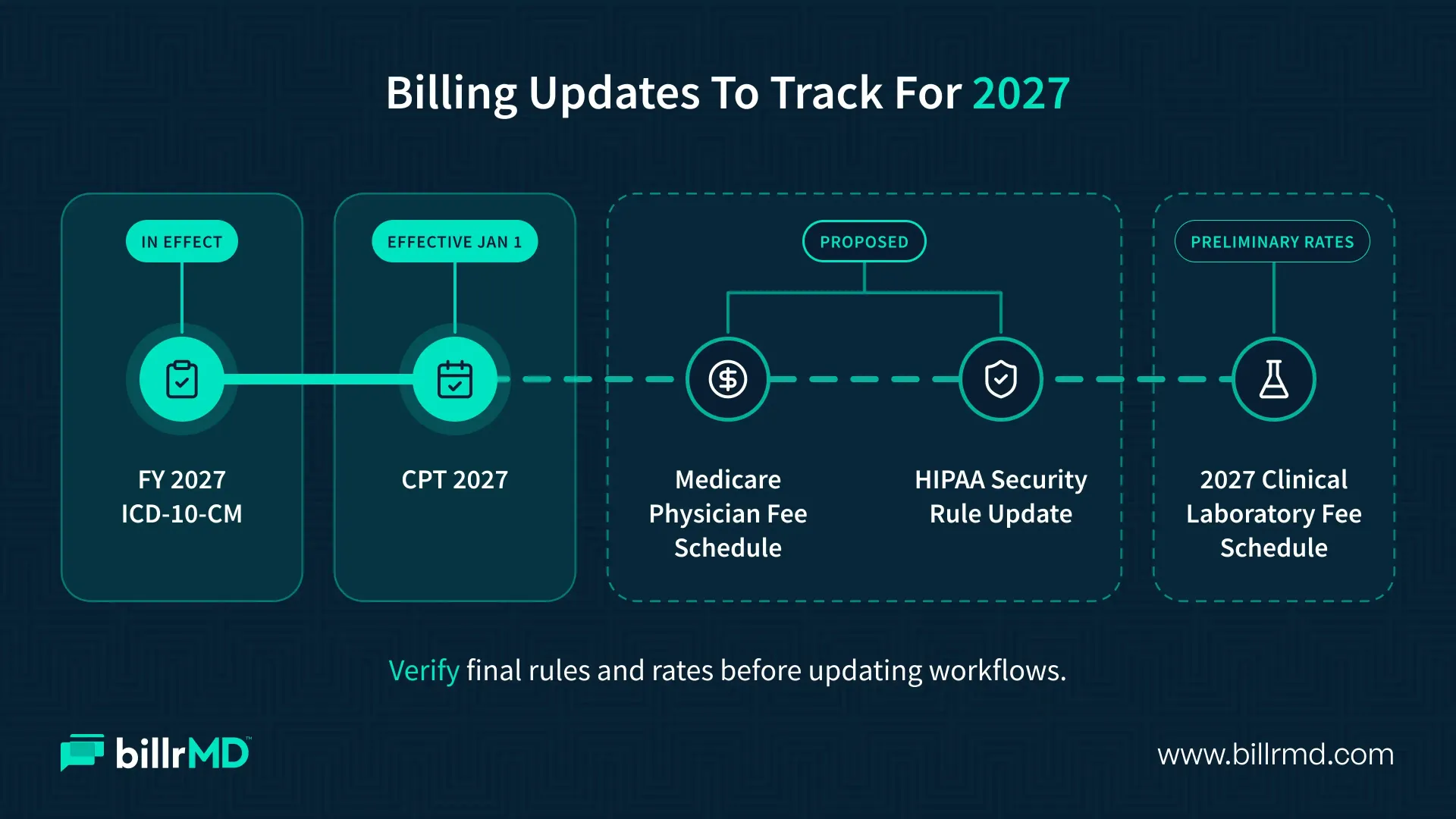
As we transition into the new year, two coding changes will affect medical billing heading into 2027. FY 2027 ICD-10-CM codes took effect October 1, 2026, while the CPT 2027 changes take effect January 1. CMS has also proposed changes to the 2027 Medicare Physician Fee Schedule.
This medical billing checklist covers seven tasks to help your practice review billing performance, update code references, prepare for payer changes, and address workflow issues before the new year.
Start 2027 With Cleaner Claims
Why Year-End Revenue Cycle Planning Matters for 2027
A claim for a December visit can be denied in February. By then, your team has moved on, and the fix costs more.
Year-end is the last point where you can find problems before they repeat across a full year of claims. Small leaks compound. A wrong code in a billing profile repeats on every claim, and a payer rule nobody updated does too.
Use this medical billing checklist as a working plan. Give each task one owner and a finish date before the year ends. Review progress weekly so your revenue cycle performance doesn’t slip during the holiday rush.
7 Year-End Tasks to Protect Your Revenue Cycle
Work through these in order. The early tasks produce the data the later ones need.
1. Review Your 2026 Financial and Billing Reports
Start with a full-year view. Pull claim aging, payment, balance, and denial reports from your medical billing software. In billrMD, the reports and analytics tools cover claim aging, balances, payments, and a denials analysis that shows which services and codes cause rejections.
Track five numbers:
- Days in AR
- First-pass acceptance rate
- Denial rate by payer
- Net collection rate
- Patient balances (older than 30, 60, and 90 days)
Then compare Q1 against Q4 so far for each one. A slow drift tells you more than a yearly average does. These numbers become your baseline for RCM performance in 2027.
Finish line: Now you can name your three worst payers by denial rate and your top five denial codes.
2. Update Your 2027 Budget and Forecast
Build the 2027 budget from 2026 actuals, not the last year’s estimated plan. Use the payer mix and visit volume from your reports as the baseline.
Then run three scenarios: flat volume, a scenario based on the proposed Medicare physician fee schedule changes covered in task 5, and higher volume. Add easy-to-miss line items, such as code books, training hours, software fees, and cybersecurity costs.
Plan to revisit the budget when CMS finalizes its fee schedule. The numbers will move.
Finish line: Now leadership has approved a base case and a downside case.
3. Prepare for CPT 2027 Code Changes
The AMA’s CPT 2027 release includes 453 editorial changes: 299 new codes, 74 revisions, and 80 deletions. The set takes effect January 1.
For maternity care, global maternity codes are replaced with separate billing for antepartum, labor, delivery, and postpartum care. Practices should focus on CPT changes relevant to their specialties. The AMA introduced 10 new AI-related codes, totaling 43, with changes in sleep medicine, hernia repair, and biofeedback.
Deleted codes cannot be reported from January 1, 2027. Review 2026 codes against the 2027 changes and update billing profiles and train coders accordingly.
Ask every software vendor when its code library updates. billrMD’s real-time claim scrubbing flags errors before submission, so an outdated code gets caught before it becomes a denial.
Finish line: Now every active billing profile and fee schedule line matches the 2027 code set.
4. Check the FY 2027 ICD-10-CM Updates
The FY 2027 ICD-10-CM code set took effect October 1, 2026, and runs through September 30, 2027. CMS posted the official guidelines for it, and following them is required under HIPAA.
Since the date has passed, treat this as an audit, not a prep task. Check three places where old codes hide: EHR favorites and superbills, billing profiles, and denial reports since October 1. Review the FY 2027 code files and addendum for new, revised, and deleted diagnosis codes, along with any applicable character requirements.
Compare any diagnosis-related rejection since October 1 against the CMS addendum. For each diagnosis-code rejection since October 1, check code validity, required characters, documentation, and payer edits before identifying the cause.
Finish line: Now you’ve traced every diagnosis rejection since October 1 to its cause.
5. Review 2027 Medicare and Payer Policy Changes
CMS proposed its CY 2027 Medicare Physician Fee Schedule in July. The proposal sets the conversion factor at $33.17 for qualifying APM participants and $32.84 for everyone else. Those are drops of 1.19% and 1.68% from 2026. The main reason is that the one-year 2.50% increase for 2026 expires. These are proposed conversion-factor changes, not a uniform reduction in every practice’s total Medicare payments.
Other proposals touch on daily billing:
- G2211 would become a modifier that raises the E/M payment by 16%.
- CMS proposes full payment for the highest-priced service when a doctor provides same-day global procedures and E/M visits. All other eligible services performed on that same day will be reimbursed at a reduced 50% rate.
- CMS would pay for remote monitoring only when your own clinical staff delivers it, not contractors.
- CMS usually issues the final rule in early November, so plan to update your forecast then.
Don’t stop at Medicare. Request 2027 policy bulletins from your top five commercial payers. Look for changes to prior authorization lists, timely filing limits, and documentation rules. If you outsource medical billing services, ask your billing partner to prepare a change sheet covering the payers your practice uses.
Finish line: Now you have a one-page payer change sheet that billers and front desk both use.
6. Strengthen HIPAA and Compliance Readiness
Medical billing compliance covers more than privacy. It includes who can see patient data, how you document, and whether your vendors protect what they hold.
HHS proposed a major HIPAA Security Rule update in January 2025. As of this writing, it isn’t final, so the current rule still applies. Use the wait to close gaps you’d need to close anyway.
Update your security risk analysis. Review user access and remove accounts for former staff. Confirm business associate agreements (BAA) with your clearinghouse and software vendors. Then complete workforce training and keep attendance records.
billrMD supports this work with role-based access controls and automated access logs for sessions involving PHI. It also sends alerts for failed logins and suspicious activity, and it uses 256-bit SSL encryption.
Finish with a small chart audit. Pull a few encounters per provider and compare the documentation to the codes billed.
Finish line: Now access is reviewed, the risk analysis is current, and every audit finding has an owner.
7. Audit and Optimize Your Billing Workflows
Map every step a claim takes, from scheduling to final payment. Note how long each handoff takes. Use claim timestamps to identify where encounters or claims are waiting longest.
Then fix problems upstream:
- Verify eligibility before the appointment and recheck closer to the date of service when needed
- Review billing profiles for frequently billed services and verify that the codes match the documentation and payer rules
- Submit claims daily instead of in weekly batches
- Let ERAs update patient accounts automatically
- Set a consistent patient-statement schedule
- Provide clear payment options for balances due after insurance processing
Compare this map with the denial report from task 1. For deeper steps, see our guide to improving revenue cycle management.
Finish line: Now each top denial reason has one fix, one owner, and one start date.
Start 2027 Strong with billrMD
A checklist works only if your tools support it. billrMD brings scheduling, eligibility checks, electronic claims submission, ERA posting, patient statements, and reporting into a fully web-based platform.
Real-time claim scrubbing catches errors before a claim goes out. Customizable reports show denial patterns by service and code. billrMD requires no local software installation or maintenance.
billrMD is built for practices, billing companies,
labs, and IDTFs. You can start with a free account, and no credit card is required.
Conclusion
Before January, review your billing reports, update coding and payer references, and assign owners to unresolved workflow issues.
Run this medical billing checklist now, assign owners, and finish before the holidays. You’ll start January with clean data, a realistic budget, and fewer surprises on your first remittance. If you need insights tailored to your practice and workflows, we’re just a phone call away.
Get Ready for 2027 with billrMD
Frequently Asked Questions
When should we finish this medical billing checklist?
Aim for mid-December. That leaves time to adjust your budget after CMS finalizes the fee schedule and to confirm your software supports the 2027 code set.
Do labs need extra steps?
If your practice operates a lab or bills tests under the Medicare Clinical Laboratory Fee Schedule, review the preliminary 2027 rates, as final rates may change. Payment for tests can’t drop more than 15% annually from 2027 to 2029.
What should we do if denials rise in January?
Run your denial report by payer and code. Check deleted CPT codes and outdated diagnosis codes first, since both code sets changed recently.
How often should we review medical billing compliance?
Do a full review once a year and run quick spot checks each quarter. Check user access, documentation samples, and vendor agreements each time.
Recent Posts