Top Medical Billing Trends Reshaping Healthcare Revenue in 2026
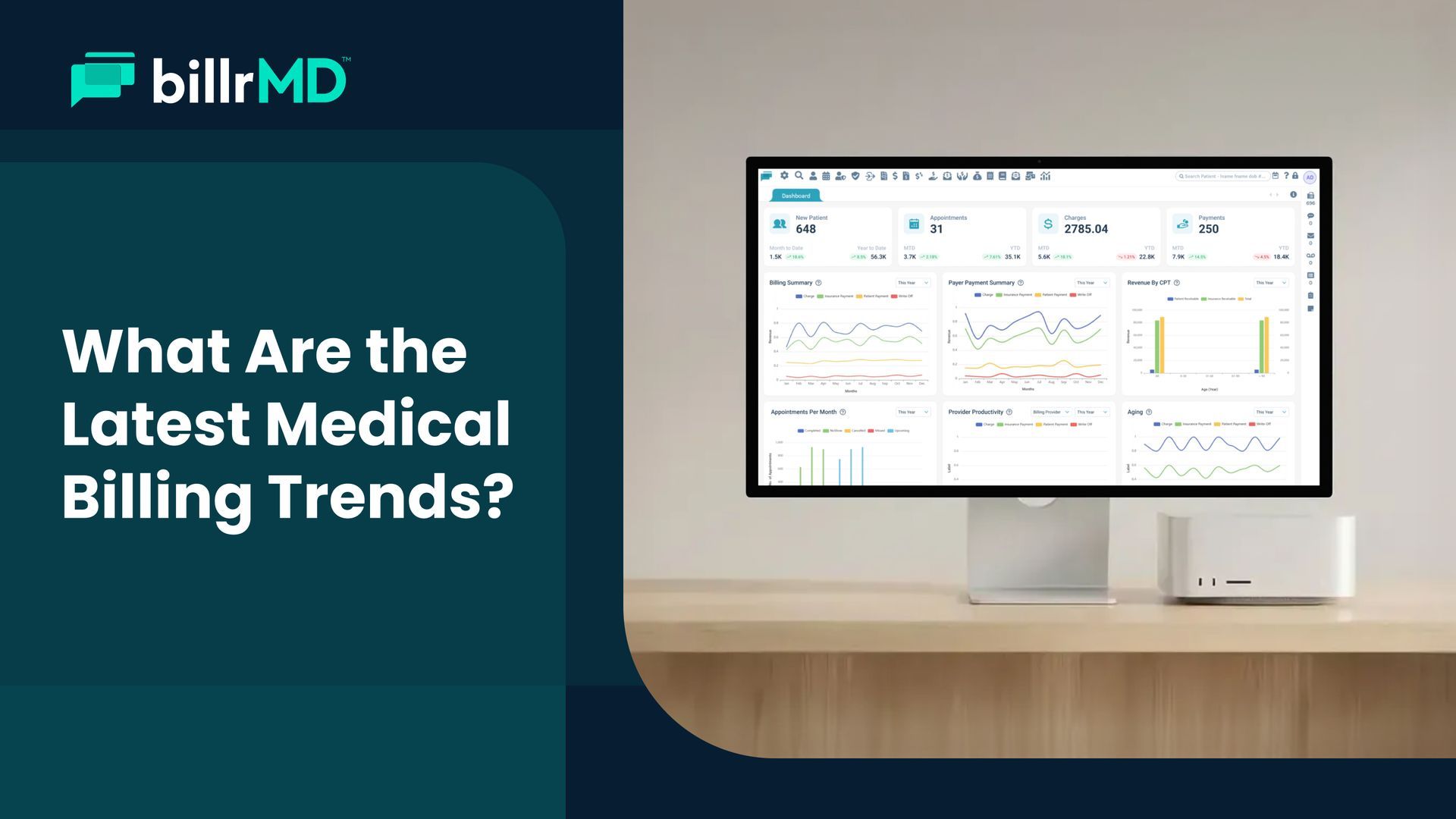
Medical billing has always demanded precision. But in 2026, the stakes feel different. Claim denial rates are rising, payer rules are growing more complex by the quarter, and the gap between practices using modern tools and those relying on manual workflows is becoming impossible to ignore.
This isn't a slow evolution. It's a meaningful shift happening right now, and the practices that understand what's driving it are the ones positioned to come out ahead financially. Whether you run a small independent clinic or a multi-provider group, staying current with medical billing trends isn't just a professional curiosity. It's a revenue strategy.
Here's a clear-eyed look at where medical billing stands in 2026, what's changing, and what it means for your practice.
Stay Ahead of Billing Shifts
The Key Medical Billing Trends Shaping 2026
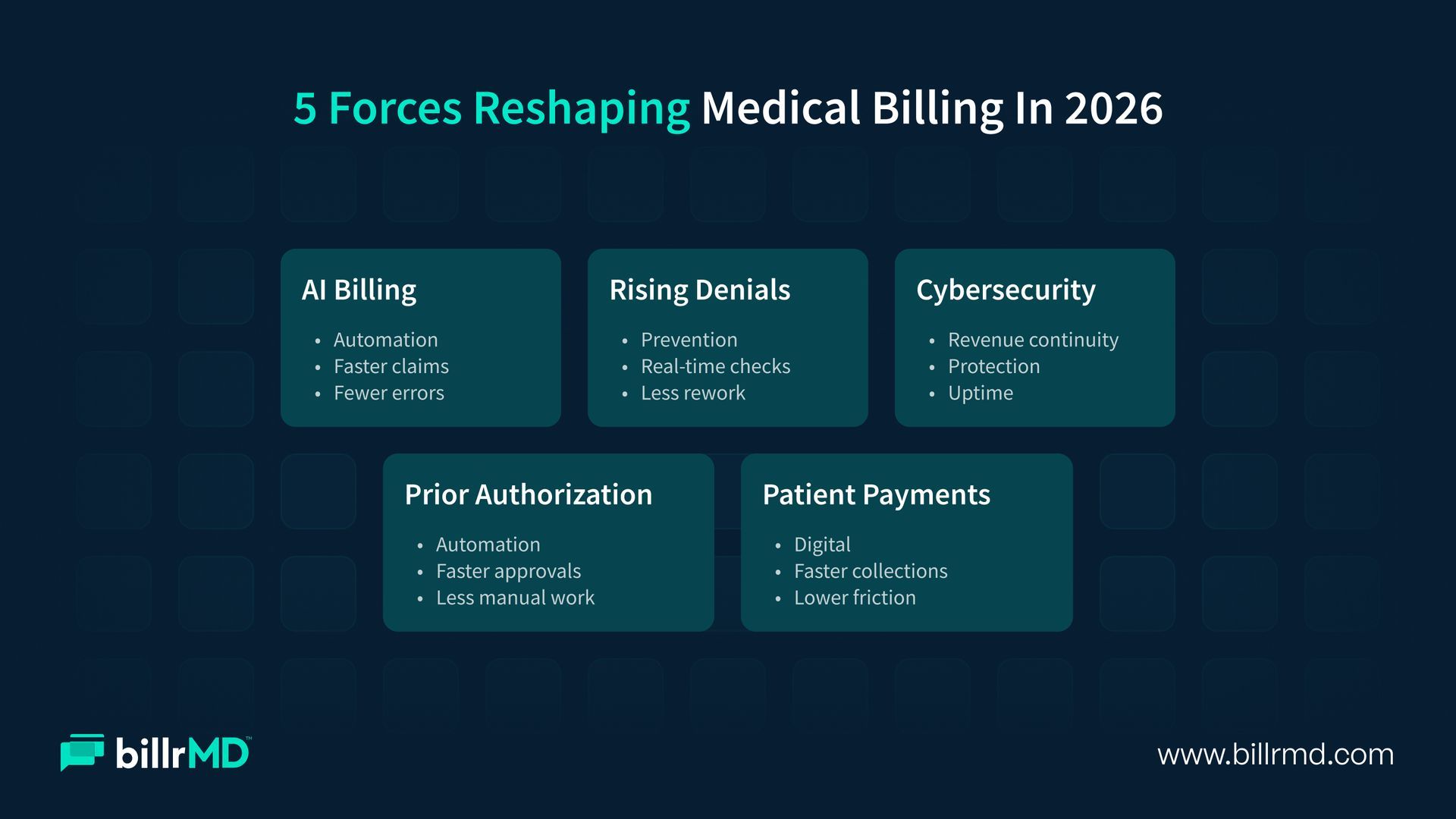
In 2026, medical billing is shaped by automation, rising administrative demands, and changing patient expectations, directly affecting financial performance and patient experience. Practices must adapt to these key trends to maintain financial resilience:
1. AI Is Moving from Pilot Programs to Core Workflows
Artificial intelligence in medical billing is no longer limited to a single context. In 2026, it's actively reshaping how revenue cycles operate at every stage: from eligibility verification before a patient walks in, to denial pattern detection before claims go out, to automated follow-up on unpaid accounts.
According to Guidehouse research, investments in medical billing automation, including AI-powered coding support, payer analytics, and prior authorization tools, ranked as the top RCM priority for medical groups in 2026. The practical result? Practices using AI-assisted claim scrubbing are flagging documentation mismatches and eligibility gaps before submission, rather than reacting to denials six weeks after the fact.
This matters for independent practices, especially. The efficiency gap between automated and manual billing workflows is widening, and it shows up directly in first-pass claim acceptance rates and days in A/R.
2. Denial Rates Are Rising, and the Response Has to Be Proactive
The Healthcare Financial Management Association (HFMA) reports that initial claim denial rates climbed to nearly 12% in 2024 and have continued into 2026. What makes this particularly costly is that a meaningful share of denied claims never gets reworked, so revenue is simply written off.
The trend among top-performing practices is shifting from denial management to denial prevention. Instead of focusing on an appeals process, they are identifying issues upfront, checking eligibility in real-time, verifying code prior to submission, and analyzing claims data to determine which claim types are most likely for be denied by certain payers.
3. Patient Collections Require a Different Playbook
This has led to an overhaul of the revenue cycle, making the patient balance a larger share of revenue for practices today than it was five years ago. Collecting on these balances requires patient experiences that make the payment process easier, not more complicated.
The medical billing industry trends around patient collections are clear: online payment portals, text-to-pay options, automated balance reminders, and itemized digital statements are quickly becoming standard expectations, not optional conveniences. Practices that present clear cost information and offer flexible, frictionless payment options are collecting more. Not because their patients are more motivated to pay, but because they've removed the friction that delays it.
4. Prior Authorization Is Getting Faster, but Only for Practices Equipped for It
Prior authorization remains one of the most administratively burdensome parts of medical billing. However, advanced prior auth technology that can make requests, track their status, and provide answers without manual intervention is rapidly maturing. For medical specializations such as cardiology, imaging, orthopedics, and behavioral health, where ‘prior auth’ is common practice, there is actual time savings for both doctors and patients.
The catch: practices that haven't integrated their authorization workflows into their billing platform are still doing much of this manually. The volume of prior auth requests isn't decreasing, which means the administrative burden for unprepared practices is only growing.
5. Cybersecurity Has Become a Billing Issue, Not Just an IT Issue
Ransomware attacks and breaches are still very common for healthcare providers, and their effects on the payment process have become even more pronounced in 2026. A cyber attack that leads to system failure can stop claim filing, delay payments, and disrupt cash flow for weeks. Cybersecurity practices will be inseparable from revenue cycle operations in 2026. Cloud-based platforms that maintain enterprise-level encryption and HIPAA compliance provide a degree of resilience that on-premises or fragmented systems often can't match.
Revenue Cycle Management Is the Thread Running Through All of It
Each of these latest medical billing trends in 2026 connects back to a single concept: revenue cycle management. RCM is not only a department or even a category of software. RCM is the entire process that makes sure that your business collects all of the revenue it has earned. Every process, from when your patients book appointments to when they pay off their bills, affects this revenue.
RCM success in 2026 will require complete visibility across all stages of the process, ensuring mistakes are caught before denial and that paying is as simple as possible for both payors and patients. This cannot be achieved without effort. It requires a platform built to support it, one that connects scheduling, eligibility, claims, and analytics without forcing your team to bridge gaps between disconnected systems.
For a deeper look at how analytics fit into this picture,
billrMD's guide on real-time billing analytics is a useful starting point.
How billrMD Helps Practices Navigate What's Ahead
billrMD was designed specifically for this kind of atmosphere. billrMD is an all-inclusive, entirely web-based solution for medical billing, scheduling, patient information management, practice management, and reporting, and it is completely HIPAA-compliant, with no additional downloads or hardware required.
In cases where rejection rates are increasing in some practices, billrMD can be beneficial due to its claim scrubbing and real-time eligibility services, which help spot errors even before a claim is submitted. With an astounding 99% first pass rate and more than 73,000 medical billing codes under ICD-10, CPT, and DSM-5, billrMD is designed to excel in billing efficiency. Since it is cloud-based, it scales with your practice without requiring a system overhaul every time your volume grows.
The benefits of medical billing software built the way billrMD is go beyond efficiency. They include the financial visibility to actually manage your revenue cycle rather than react to it, something that matters more in 2026 than it ever has.
Closing Thoughts
The medical billing process in 2026 may be difficult to master; however, if the practice uses appropriate solutions, it will be relatively easy to manage. This year’s trends are not just a disruption in the healthcare industry but will become the norm in the future.
The question isn't really whether these shifts are happening. They are. The more useful question is whether your billing infrastructure is built to keep up with them, or whether it's creating friction that your team has to work around every single day.
See billrMD in Action
Frequently Asked Questions
What is the biggest medical billing trend in 2026?
AI-powered automation is the most significant shift. It's being applied across the revenue cycle, from eligibility verification and claims scrubbing to denial prediction and patient billing, and is directly affecting first-pass acceptance rates and A/R days for practices that have adopted it.
How does automation in medical billing reduce claim denials?
Eligibility is confirmed prior to making an appointment for patients, codes are cross-referenced for any specific requirements by the payer, and documentation issues are caught even prior to filing. This prevents the practice from identifying the issues only when the claim gets denied.
Why is revenue cycle management more important in 2026?
Rising denial rates, increased patient payment responsibility, and more complex payer requirements have all increased the financial risk of running a reactive billing operation. RCM gives practices the structure and visibility to manage billing proactively, which directly affects cash flow and operational efficiency.
What features should a medical billing software have in 2026?
At the very least: eligibility verification in real-time, claim scrubbing, ERA, denial management and analysis, patient billing capabilities with electronic payments, and interface capabilities directly to your EHR or PM system. Systems that combine all of these features eliminate many of the areas where problems are most likely to occur.
Recent Posts