How to Find the Best Medical Billing Software for Your Practice

Every practice reaches a point where managing billing with spreadsheets, aging software, or disconnected systems becomes unsustainable. A
research analysis of over 1.5 million patient visits found that roughly 1 in 4 claim denials from primary care office visits were attributed to coding errors alone.
At that point, the key question is not whether to invest in superior tools, but rather which platform truly deserves your investment.
The
best medical billing software doesn't announce itself with the longest feature list or the flashiest demo. It's the one that fits your workflow, integrates with your existing systems, and handles the complexity of your specific billing structures without requiring your team to become software experts. Getting there takes a little groundwork, and that's what this guide is here for.
Your Revenue Cycle, Simplified
What Every Practice Should Know Before Buying Billing Software
Most software decisions go sideways early, not because the platform was bad, but because the buyer didn't start with a clear picture of what they actually needed. Before you decide to buy medical billing software or even request a demo, do an honest assessment of where your current process breaks down.
Is your clean claim rate lower than it should be?
Are eligibility errors creating billing surprises after appointments?
Is your team spending a disproportionate amount of time on data entry between systems that don't talk to each other?
These aren't just operational annoyances. They're revenue leaks, and they should directly shape your evaluation criteria.
Integration is the foundation
A billing platform that doesn't connect with your EHR forces staff to move data manually, which means more errors and a fragmented view of your financial performance. Tight integration between your clinical and billing workflows isn't a bonus feature; it's the baseline.
Cloud-based is the practical standard
On-premise software requires local servers, manual updates, and IT maintenance that most practices don't want to manage. A web-based platform is accessible from anywhere, updated automatically, and doesn't require your billing team to be in a specific office to work. For multi-location practices or teams that work in a hybrid manner, this matters considerably.
Claim scrubbing is a non-negotiable
Before any claim goes out, automated logic should be checking it against your payer's rules: missing fields, mismatched codes, unsupported modifiers. This one feature has a measurable and direct impact on your first-pass acceptance rate. Without it, you're essentially proofreading claims manually, which doesn't scale.
Hidden costs compound quickly
Some platforms charge per claim, while others include setup fees or offer separate support options. It's important to understand the complete cost structure before making a commitment. A lower monthly rate that includes per-claim fees and onboarding can provide flexibility and potentially be more cost-effective for practices of various sizes initially.
Finally, think past today. The platform that's right for your current volume and structure should also make sense when you add providers, expand to a second location, or shift your billing model. Outgrowing your system in two years isn't a growth problem. It's a planning problem.
Comparing Different Medical Billing Software Options
Once you have clarity on your needs, you can start to meaningfully compare medical billing software options. This is where most practices either make a smart decision or spend six months on a platform that wasn't really built for them.
Standalone vs. Integrated
Standalone billing software handles only the revenue cycle: claims, denials, payment posting, and collections. These tools can be well-built, but they operate separately from your EHR and scheduling system, which means data still has to move between platforms, either manually or through a third-party connector.
Integrated platforms combine billing, EHR, practice management, and scheduling into a single system. Clinical documentation flows directly into a claim. Scheduling information populates eligibility checks automatically. The result is fewer handoff gaps, fewer duplicate entries, and a unified view of both clinical and financial performance. For practices prioritizing operational simplicity, this is usually the stronger approach.
Specialty-Specific vs. General
General billing platforms are designed to work across a range of specialties and offer broad flexibility. Specialty-specific platforms come pre-configured with the code sets, payer rules, and workflow templates relevant to fields like behavioral health, physical therapy, or cardiology. If your practice has highly niche documentation requirements, a specialty-built system can save time on configuration. However, many modern platforms, including flexible solutions like billrMD, are designed to support multiple specialties within a single system. This makes them a better fit for multi-specialty practices or organizations that expect to grow.
Evaluating Your Shortlist
When comparing platforms side by side, look at these factors in parallel rather than in isolation: EHR integration quality, claims scrubbing depth, real-time eligibility verification, denial management workflow, reporting capabilities, support availability, and total cost of ownership. Don't evaluate based on a scripted demo. Ask the vendor to walk through your actual use cases, including a denial scenario and a complex eligibility situation, and see how the system responds.
How Do Medical Billing Companies Drive Revenue for Your Practice?
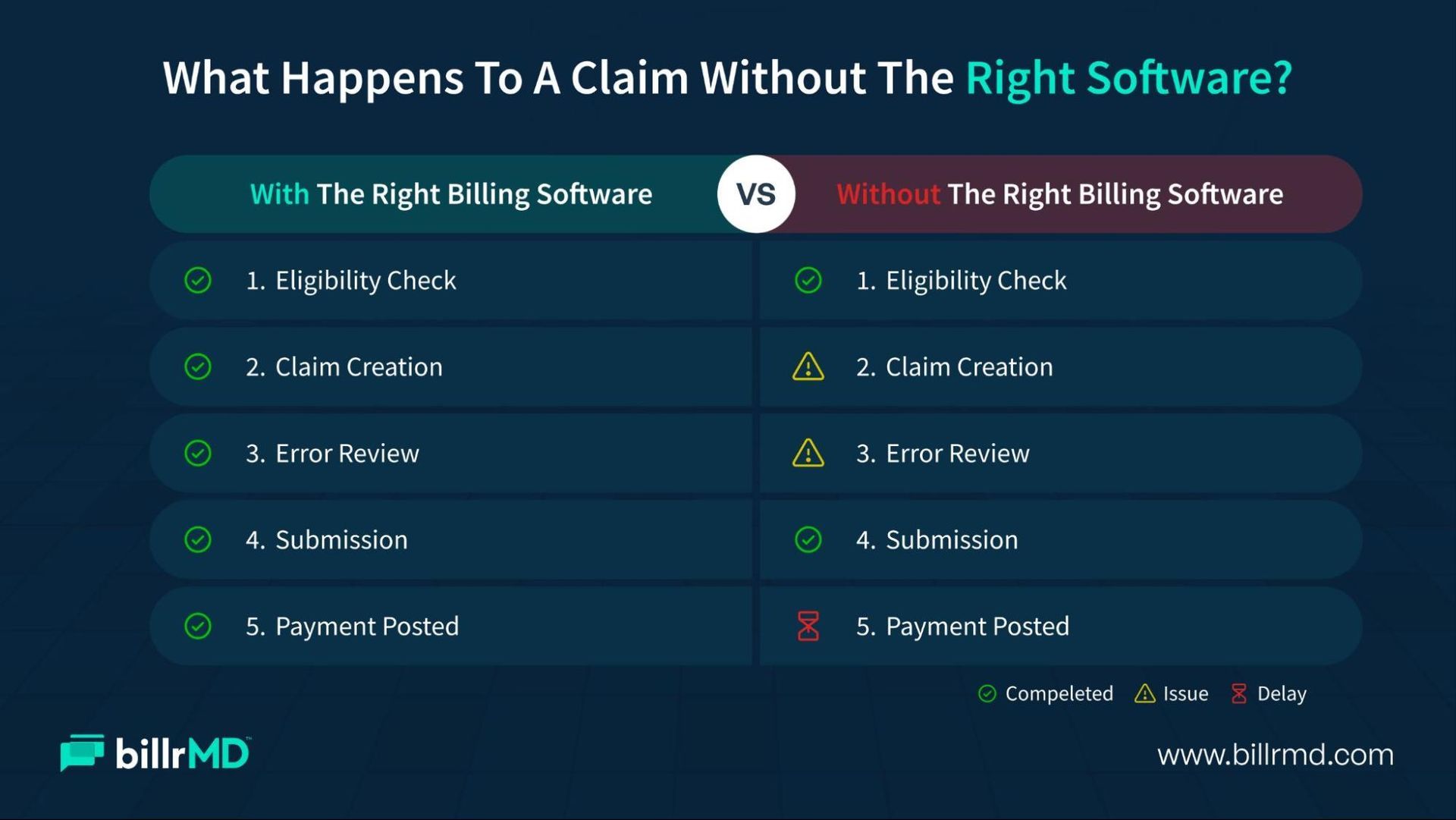
There's an important distinction worth making here. Medical billing companies are third-party organizations that take on your revenue cycle management as a service. They handle claims, denials, payment posting, patient collections, and reporting on your behalf. The question isn't whether they can be valuable. Often, they are. The question is whether outsourcing is right for your practice's specific situation, and what role software plays regardless of which path you choose.
The revenue impact of working with a billing company typically comes through a few channels. Their coders know payer rules in depth, which reduces denial rates on submission. Their follow-up processes on unpaid claims are more systematic than what most in-house staff can manage while handling other responsibilities. And they stay current on regulatory changes, which reduces compliance-related risk.
The tradeoff is reduced visibility and control. You're dependent on another organization's processes, communication style, and turnaround times. Clear SLAs and regular reporting are non-negotiable if you go this route.
For practices that want to keep billing internally but close the expertise gap, the answer often comes back to software. The right platform provides your team with automated error-checking, denial tracking, and reporting tools that narrow the performance gap between an experienced billing company and a well-supported in-house team. And for practices still deciding between the two models, some platforms support both, meaning you can run in-house today and transition to an external partner without switching systems.
The Long-Term Benefits of Medical Billing Software
The immediate case for billing software is efficiency. The longer-term benefits of medical billing software are what make the investment compound over time.
Financial visibility that actually changes behavior:
Billing software gives you real-time insight into where your revenue is: which claims are pending, which payers are slow, what your denial rate looks like by code, and how collections are trending month over month. That kind of data turns reactive problem-solving into proactive financial management. You stop finding out about issues weeks after they've already cost you.
Lower administrative overhead:
Automation handles the rules-heavy, repetitive parts of billing. Eligibility verification runs before the appointment. Claims are scrubbed automatically before submission. Payments post through ERA without manual entry. Your team's time shifts from data entry toward exceptions, appeals, and patient communication.
Faster cash flow:
Cleaner claims go out faster. Automated follow-up on unpaid balances reduces your collection cycle. For practices operating on tighter margins, the acceleration between service delivery and payment receipt isn't a minor operational gain. It's a meaningful financial one.
Scalability without proportional cost increase:
A well-built billing platform handles increased volume without requiring you to add billing staff proportionally. When you bring on a new provider or add a location, the software scales with you.
Reduced compliance burden:
Coding standards are updated regularly. Payer rules shift. A maintained billing platform stays current with these changes automatically, which takes a real and ongoing burden off your administrative team.
For practices weighing whether to
buy medical billing software or stay with what they have, these long-term advantages tend to decisively justify the investment. The question shifts from "whether" to "which one."
Why billrMD?
billrMD is a fully web-based medical billing and practice management platform built for the operational realities of modern healthcare practices. There's nothing to install, no server to maintain, and no version of the software that requires your IT person to get involved. Everything runs through a secure web browser.
The platform's claim scrubbing engine checks every submission against a library of more than 73,000 ICD-10, CPT, and DSM-5 codes before it goes out, which helps explain billrMD's 99% first-pass acceptance rate. Real-time eligibility verification, ERA-powered automated payment posting, and fully configurable patient invoicing are built into the same workflow, not bolted on as separate modules.
For practices that need financial visibility, billrMD's reporting tools surface the metrics that matter: denial trends, A/R aging, payer performance, and collection rates, all from a single dashboard. The platform is built to support both in-house billing teams and practices working with external billing partners, so your software doesn't constrain your operational model.
Whether you're a solo provider managing billing on a lean team or a growing group practice with a dedicated billing department, billrMD is designed to meet you where you are and scale with you.
Conclusion
Choosing the best medical billing software for your practice is one of the most consequential operational decisions you can make. The wrong platform creates friction, obscures financial performance, and costs you revenue you may not even realize you're losing. The right one gives your team the infrastructure to work efficiently, catch problems early, and get paid consistently for the care you're delivering.
The path to a good decision isn't complicated: know your specific pain points, compare platforms against criteria that actually matter to your workflow, and choose something built to grow with you. Your billing infrastructure should be an asset. The right software makes that a realistic expectation, not an aspirational one.
See the Difference for Yourself
Frequently Asked Questions
What's the difference between medical billing software and practice management software?
Medical billing software focuses on the revenue cycle: claims, payments, denials, and collections. Practice management software covers a broader set of administrative functions, including scheduling, patient records, and reporting. Many modern platforms, including billrMD, combine both into a single integrated system, which reduces the need to manage separate tools.
How do I know whether to handle billing in-house or work with medical billing companies?
It depends on your team's capacity, expertise, and the complexity of your payer mix. In-house billing works well when you have trained staff and the right software in place. Outsourcing tends to make sense when you lack the bandwidth to consistently manage denials and appeals, or when billing complexity exceeds what your current team can handle effectively. Some platforms support both models, which gives you flexibility as your practice evolves.
What features should I prioritize when comparing medical billing software platforms?
Start with the fundamentals: EHR integration quality, claim scrubbing accuracy, real-time eligibility verification, denial management tools, and reporting depth. Beyond features, evaluate support availability, implementation timeline, and the total cost structure, including any per-claim fees or add-on charges.
Is cloud-based billing software secure enough for patient data?
Reputable cloud-based platforms use enterprise-grade encryption and are built to meet HIPAA security standards. In most cases, their security infrastructure exceeds what a small or mid-sized practice could realistically maintain on a local server.
Recent Posts