Best Medical Billing Software for Small Business in 2026

If your billing process still involves a lot of manual steps, fragmented tools, or a stack of unresolved denials, you already know how much that costs. Not just in time. In actual revenue.
For independent practices and small clinics, the margin for billing errors is thin. A misapplied modifier, an eligibility verification that never occurred, or a claim that went out with mismatched diagnosis codes can delay reimbursements by weeks or kill them entirely. And with payer rules getting more detailed every cycle, doing this manually is increasingly not an option.
That's exactly what medical billing software for small businesses is designed to solve. But the market is crowded, the feature lists all look similar on paper, and picking the wrong platform means months of disruption you didn't budget for.
This breakdown covers seven of the most widely used billing platforms available in 2026, what each one actually delivers, and who each one is realistically built for, so you can make a confident decision without the guesswork.
Bill Smarter, Not Harder
What to Look for Before You Start Comparing
Not every billing platform is a realistic fit for a small practice. Before you look at any specific tool, it helps to know the non-negotiables for your scale.
- Automated Claims Scrubbing:
This feature automatically checks for coding errors before submission, serving as your most powerful tool for increasing first-pass acceptance rates and reducing denials. - Real-Time Eligibility Verification:
Instantly confirm patient insurance coverage and benefits before the appointment to prevent billing headaches and ensure you get paid for services rendered. - Actionable Reporting & Analytics:
Access clean, easy-to-read reports that give you a clear view of your practice’s financial health and help you identify bottlenecks in your revenue cycle. - Scalable Pricing Models:
Look for a transparent pricing structure that supports your growth rather than penalizing you with hidden fees as your patient volume increases. - Seamless EHR Integration:
Whether through a native connection or a reliable API, ensuring your billing software "talks" to your Electronic Health Records is essential for reducing manual data entry and errors. - Rapid Onboarding and Ease of Use:
A platform should be intuitive enough to get you up and running quickly. If submitting a basic claim requires weeks of intensive training, the software may be too complex for a streamlined small practice.
The options below were evaluated with exactly these practical priorities in mind.
The Best Medical Billing Software for Small Businesses in 2026
Finding the best medical billing software for small businesses in 2026 requires looking past marketing claims to see which tools actually improve your daily revenue cycle. Here are our top picks for the year:
1. billrMD
billrMD is a fully web-based platform designed for medical practices, billing companies, laboratories, and IDTFs seeking a complete billing and practice management solution without the overhead of traditional enterprise software. There's nothing to download or install. You open a browser, log in, and your entire revenue cycle is there.
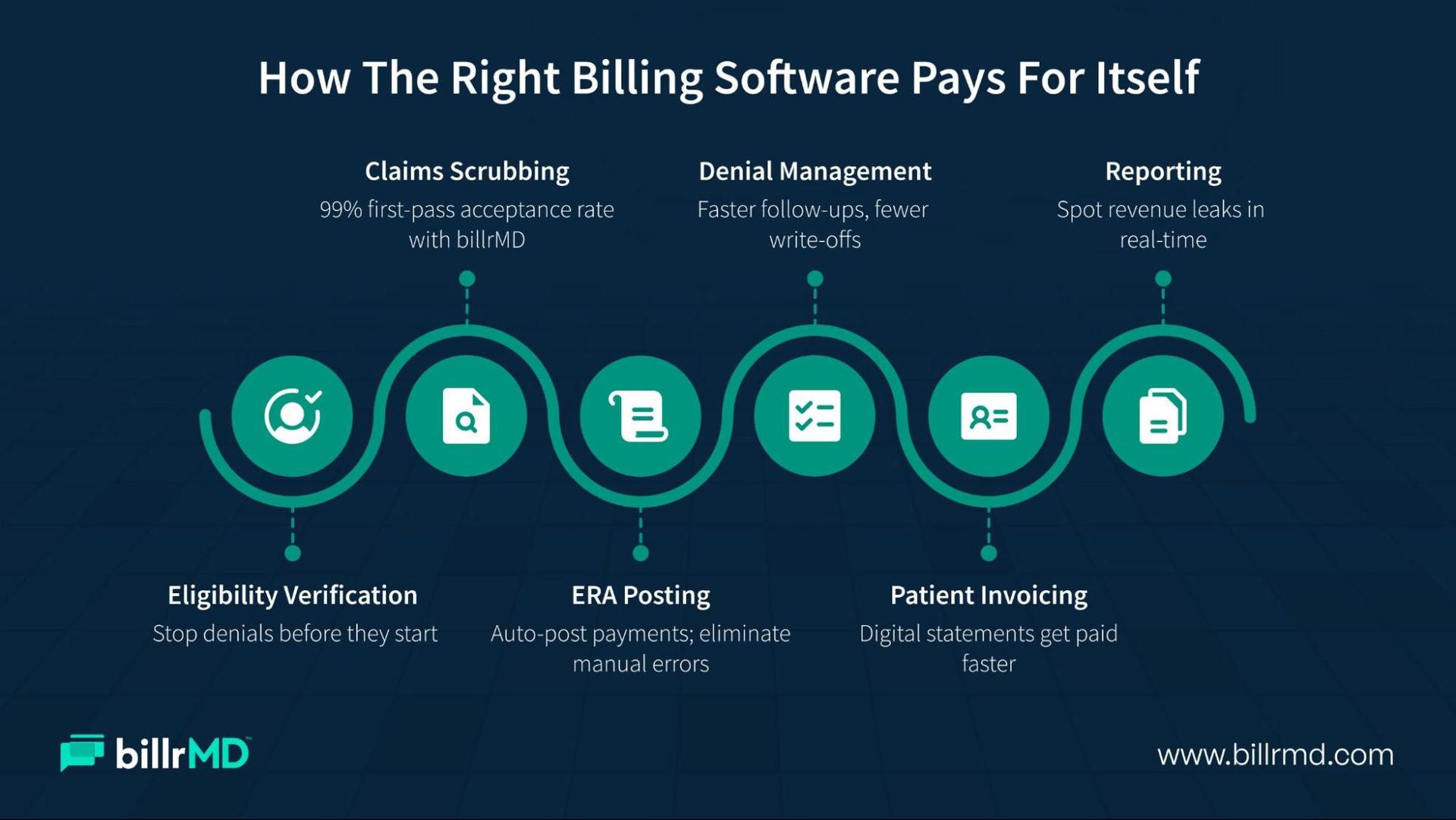
For small practices specifically, the combination of depth and usability is what stands out. The platform supports over 73,000 billing codes across ICD-10, CPT, and DSM-5, which means it covers virtually every specialty without requiring you to build custom code sets from scratch. Its integrated clearinghouse and claims scrubbing engine contribute to a 99% first-pass acceptance rate, directly reducing the time your team spends on denials and resubmissions.
Key features include:
- Real-time insurance eligibility verification sent directly to the clearinghouse
- Electronic Remittance Advice (ERA) with automated payment posting and batch entry
- Customizable patient invoicing with both balance and ledger statement formats, plus practice branding
- Built-in custom reporting across every stage of the revenue cycle, including claims aging, provider productivity, and payer payments
- Drag-and-drop scheduling with automated appointment reminders via email or text
- Multi-user role management to keep PHI access appropriate for each staff member
The platform also supports in-house and managed billing workflows equally well, so it works whether your team handles billing directly or you partner with an external billing service. You can start with a complimentary account without entering a credit card, and unlock premium features as your practice grows.
With military-grade encryption, daily backups, and HIPAA compliance built in, security is handled at the infrastructure level rather than requiring separate configuration. Learn more about the full billrMD platform.
Best for: Independent practices of any specialty, billing companies, labs, and IDTFs looking for a scalable, affordable, and genuinely complete billing platform that doesn't require a lengthy implementation process.
2. Kareo (Now Tebra)
When evaluating medical billing software for small business options,
Tebra (formerly Kareo) remains a recognizable option for solo providers with uncomplicated billing needs. For solo providers and very small practices with relatively uncomplicated billing, it remains a recognizable and accessible option.
The interface is reasonably intuitive, claim management covers the basics, and the bundled patient engagement features are convenient for practices that want scheduling, billing, and patient communication in one place. That said, users frequently note that reporting capabilities feel limited compared to those of more data-driven platforms, and pricing can increase significantly as additional features are added.
Best for: Solo practitioners or two-to-three provider practices with straightforward billing needs who also want patient engagement tools built into the same system.
3. AdvancedMD
AdvancedMD is a feature-heavy platform built for practices that need depth across billing, EHR, scheduling, and analytics. Its reporting and financial dashboard capabilities are among the strongest offerings in this category, and the platform can handle complex workflows across multi-provider environments.
The trade-off is significant at the small-practice level: implementation takes time, the interface has a notable learning curve, and pricing typically starts at around $599 per provider per month. Practices without a dedicated billing or IT resource often find the setup process more demanding than anticipated.
Best for: Mid-to-large practices or specialty groups with complex billing requirements and the internal bandwidth to support a longer implementation and configuration process.
4. athenahealth (athenaCollector)
athenahealth's billing module, athenaCollector, is part of the broader athenaOne platform. It's consistently cited for its wide payer network connectivity, regular product updates, and the rules engine it uses to flag potential claim issues before submission.
The main friction for smaller practices is cost structure. Pricing is typically calculated as a percentage of collections, making the total cost difficult to predict as your revenue grows. Some users also report that certain workflows feel less polished than the platform's reputation suggests, particularly for teams without prior experience on the system.
Best for: Practices that prioritize broad payer network access and are comfortable with percentage-based pricing rather than a predictable per-provider monthly fee.
5. DrChrono
DrChrono positions itself as a flexible, cloud-based platform with strong mobile functionality and solid EHR integration. It is purpose-built for providers who need to manage billing on the go, including telehealth practices and providers who do rounds across multiple locations.
Specialty-specific customization is a genuine strength here. The platform supports custom templates across a wide range of practice types and has historically been well-regarded by smaller specialty practices that need flexibility without a large support team. Pricing is available upon request, which does make direct comparisons harder upfront.
Best for: Mobile-first providers, telehealth-focused practices, and small specialty teams that need flexible billing workflows they can manage from anywhere.
6. CareCloud
CareCloud is a cloud-based suite that combines revenue cycle management, scheduling, and patient engagement in a relatively user-friendly interface. It's often noted for being easier to navigate than alternatives, which makes it accessible for practices that can't afford a long training runway.
Claim scrubbing, ERA posting, denial management, and patient-facing payment tools are all included. The main limitation is pricing transparency. CareCloud requires a custom quote, so you won't know your costs until you've gone through a demo, which makes it harder to compare quickly against other options.
Best for: Growing practices that want a user-friendly platform with modern patient engagement features and don't mind committing to a sales conversation before comparing pricing.
7. NextGen Healthcare
NextGen is a long-established platform with a strong compliance track record, specialty-specific workflow configurations, and integrated RCM services for practices that want managed billing alongside their software tools. It covers scheduling, EHR, and billing within one ecosystem.
Implementation tends to be time-intensive, and the cost structure puts NextGen on the higher end of the market. For practices with limited administrative resources, the complexity of setup can outweigh the feature advantages unless you're buying into the full suite with implementation support.
Best for: Established practices with a dedicated administrative team, complex compliance needs, and the budget and bandwidth for a comprehensive, customizable platform.
Why Small Practices Keep Coming Back to billrMD
The most consistent complaints about billing software at the small practice level tend to cluster around the same core issues: platforms designed for hospitals that feel wildly overcomplicated at a solo or five-provider scale, pricing that isn't sustainable at lower patient volumes, and support that disappears after implementation.
billrMD was built to sit on the opposite end of that spectrum. As a purpose-built medical billing software for small businesses with more than 25 years of experience in the healthcare technology space, the platform is designed to be genuinely usable from day one, not just functional after months of customization.
The free starting account is meaningful here. There's no credit card required, no commitment, and no stripped-down demo version. You get access to the platform and can scale into premium features as your practice grows. That approach matters for small practices that can't afford to make a major software investment based entirely on a sales demo.
The platform's billing profiles are worth calling out specifically. They let you pre-load your most common diagnosis and procedure code combinations, which dramatically reduces data entry time for routine encounters and helps maintain coding consistency across your team. Combined with the built-in reporting that surfaces claims aging, denial patterns, and payer payment performance, you end up with a clearer picture of your revenue cycle than most small practices have seen before.
For a detailed look at how the platform handles the full billing workflow, the billrMD video library includes feature-by-feature walkthroughs across scheduling, eligibility, claims, ERA, and patient invoicing.
Experience the billrMD Advantage
Frequently Asked Questions
What are the best medical billing software for small businesses in 2026?
The right fit depends on your practice's size, specialty, and patient volume. For small practices needing a scalable, web-based platform, billrMD is a strong choice, covering the full revenue cycle without requiring additional software or hardware.
How is medical billing software different from an EHR?
An EHR manages clinical data and patient history, while medical billing software handles financial workflows like claims and payments. Some systems combine both functions, so clarifying your needs significantly narrows your options. Check billrMD's FAQ for more details.
Is cloud-based billing software actually secure?
Reputable providers use enterprise-grade encryption, daily backups, and HIPAA-compliant security that often surpasses small practices. For example, billrMD utilizes military-grade encryption and continuous security updates as part of its infrastructure.
Can a small practice afford professional billing software?
Web-based pricing models have made professional-grade tools accessible to practices of all sizes. Many platforms, like billrMD, offer free or low-cost tiers to evaluate systems before committing to premium features.
Recent Posts